Benefits decisions rarely get the same boardroom attention as other major line items in a company budget. Yet for most employers, health insurance and related benefits represent one of the largest expenses they carry each year, often second only to payroll. When that expense grows year after year without a clear strategic conversation behind it, the costs compound and the opportunities to manage them shrink.
The good news is that you do not need a formal presentation or a lengthy process to bring benefits into a meaningful leadership conversation. You need the right questions, the right data, and a clear sense of what you are trying to accomplish. This post gives you a practical framework for doing exactly that.
Why This Conversation Is Worth Having
In many organizations, benefits decisions default to HR or operations because those teams handle the administrative work. Finance gets looped in at renewal time to approve the budget impact, and ownership may weigh in if costs are particularly high. But a real strategic conversation, one where leadership collectively examines what the benefits program is doing, what it is costing, and whether it is aligned with business goals, happens far less often than it should.
That gap matters for a few reasons. First, benefits are a retention and recruiting tool, and leadership should understand whether their current package is competitive for the talent they are trying to attract. Second, healthcare cost trend is one of the few expense categories that routinely grows at rates well above inflation, and it deserves the same scrutiny applied to any other significant business cost. Third, the decisions made at renewal time, even small ones, can have multi-year financial consequences that leadership should be aware of before they happen.
Bringing benefits into a structured leadership conversation, even once a year, changes how those decisions get made.
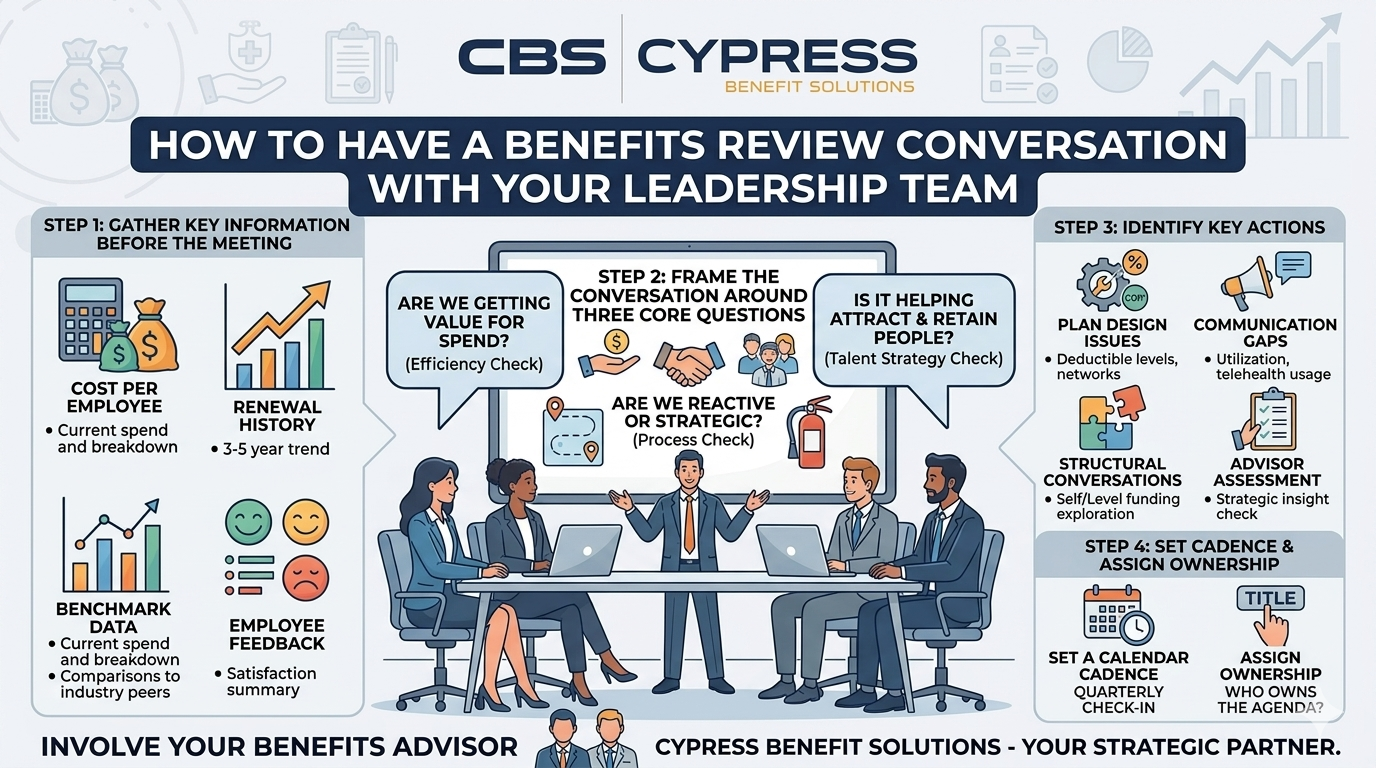
Step One: Pull Together the Right Information Before the Meeting
A benefits review conversation is only as useful as the information it is built on. Before you sit down with your leadership team, gather the following so the discussion can be grounded in facts rather than impressions.
Your Current Cost Per Employee
Know what you are spending per employee per year on benefits, including both the employer and employee contribution. If you have this broken out by plan or benefit type, even better. This number gives leadership a concrete anchor for the conversation and makes it easy to compare against benchmarks.
Your Renewal History
Pull together your premium or cost history for the past three to five years. What has the year-over-year increase looked like? Has it been consistent, accelerating, or variable? Understanding the trend is more useful than knowing any single year’s number in isolation.
Benchmark Comparisons
If your benefits advisor can provide benchmarking data showing how your cost per employee and plan design compare to similar employers in your industry and region, bring that to the meeting. Leadership teams respond well to context. Knowing whether your spend is above, below, or in line with peers helps frame the conversation productively.
Employee Feedback or Satisfaction Data
If you have conducted any employee surveys that touched on benefits satisfaction, summarize the relevant findings. If you have not, even anecdotal feedback from HR about common employee questions or complaints can be useful. Leadership should understand how employees perceive the current package, not just what it costs.
Your Current Plan Structure
Be prepared to give a brief overview of what you currently offer, including health plan options, ancillary benefits, and any voluntary or supplemental programs. Leadership should have a clear picture of what is actually in the package before discussing whether it is the right package.
Step Two: Frame the Conversation Around Three Core Questions
Once you have the information assembled, structure the conversation around three questions that most leadership teams find intuitive and productive.
Are We Getting Value for What We Are Spending?
This is the cost efficiency question. It is not asking whether the plan is cheap, but whether the money being spent is producing the intended outcome. A leadership team that is spending above benchmark on benefits but has low employee satisfaction and high turnover is not getting value. One that is spending at benchmark and retaining strong talent with high benefits satisfaction likely is. The answer to this question sets the tone for everything else.
Is Our Benefits Package Helping Us Attract and Retain the People We Need?
This is the talent strategy question. Leadership should be able to speak to whether benefits have come up in recruiting conversations, whether departing employees have cited benefits as a factor in their decision to leave, and whether the current package aligns with the expectations of the workforce they are trying to build. This is not always easy to measure precisely, but it is a question leadership should have a perspective on.
Are We Making Benefits Decisions Reactively or Strategically?
This is the process question and often the most important one. Are benefits decisions being made with a long-term plan in mind, or is leadership simply responding to whatever the renewal brings each year? Is there a shared understanding of where the company wants its benefits program to be in two or three years? If the answer is no, this conversation is a good place to start building that direction.
Step Three: Identify the One or Two Things Worth Acting On
A leadership benefits review does not need to produce a long list of action items. In most cases, the most productive outcome is identifying the one or two areas that most deserve attention before the next renewal cycle. Here are the categories worth considering.
Plan Design Issues
Are there specific features of the current plan, such as the deductible level, the network, or the contribution split, that are creating problems for employees or driving unnecessary cost? If so, flag these as areas to explore with your benefits advisor before the next renewal rather than waiting until renewal pressure forces a rushed decision.
Communication Gaps
Do employees understand what they have? Are they using the benefits available to them, including telehealth, the EAP, and preventive care? If utilization data or employee feedback suggests significant gaps, improving benefits communication is a high-return investment that costs relatively little.
Structural Conversations Worth Starting
Are there funding structures, such as level-funded or self-funded arrangements, that your company has never seriously evaluated but might be worth exploring given your size and workforce profile? Are there supplemental or voluntary benefit categories that could improve employee satisfaction without significantly increasing employer cost? These are conversations that take time to work through properly and are best started well before renewal season.
Advisor Relationship Assessment
Is your benefits broker or advisor actively bringing you strategic insight throughout the year, or are they primarily showing up at renewal time? Leadership should have a view on whether the advisory relationship is producing the value it should. If not, that is worth addressing sooner rather than later.
Step Four: Set a Cadence and Assign Ownership
The most common reason benefits conversations stay reactive is that nobody owns the responsibility for making them proactive. Before closing the leadership review, agree on two things: who is responsible for keeping benefits on the leadership agenda throughout the year, and how often that update will happen.
For most companies, a quarterly benefits check-in at the leadership level is appropriate. This does not need to be a long meeting. A fifteen-minute update on how costs are tracking, whether any employee feedback has surfaced, and whether anything in the market warrants attention is often enough to keep leadership informed and engaged between annual renewals.
Assigning ownership, whether that sits with HR, finance, or an operations leader, ensures the conversation does not fall back into a once-a-year reactive pattern.
A Note on Involving Your Benefits Advisor
The most productive version of this leadership conversation often includes your benefits advisor, either in the room or in the preparation leading up to it. A good advisor can provide the benchmarking data, claims context, and market perspective that makes the conversation substantive rather than speculative. They can also help translate complex plan information into the business language that leadership teams find most useful.
If your current advisor is not someone you would feel comfortable bringing into a leadership conversation, that is itself useful information about the nature of the relationship.
At Cypress Benefit Solutions, we regularly participate in exactly these kinds of conversations with our employer clients. If you would like help preparing for a benefits review with your leadership team, or if you would like us to be part of that conversation, we would welcome the opportunity. Reach out anytime to get started.