Q4 is one of the busiest stretches of the year for employee benefits compliance, and several deadlines land within weeks of each other. Most employers rely on a broker, carrier, or third party administrator to handle these notices and filings, and in most cases that reliance is well placed. It is still the employer’s obligation at the end of the day, and a quiet assumption that someone else took care of it is not the same thing as confirming they did.
This is not meant to be another generic list. It is a walkthrough of what actually matters this quarter, why each requirement exists, and what is worth confirming before the deadline passes rather than after.
What Needs to Happen Right Now
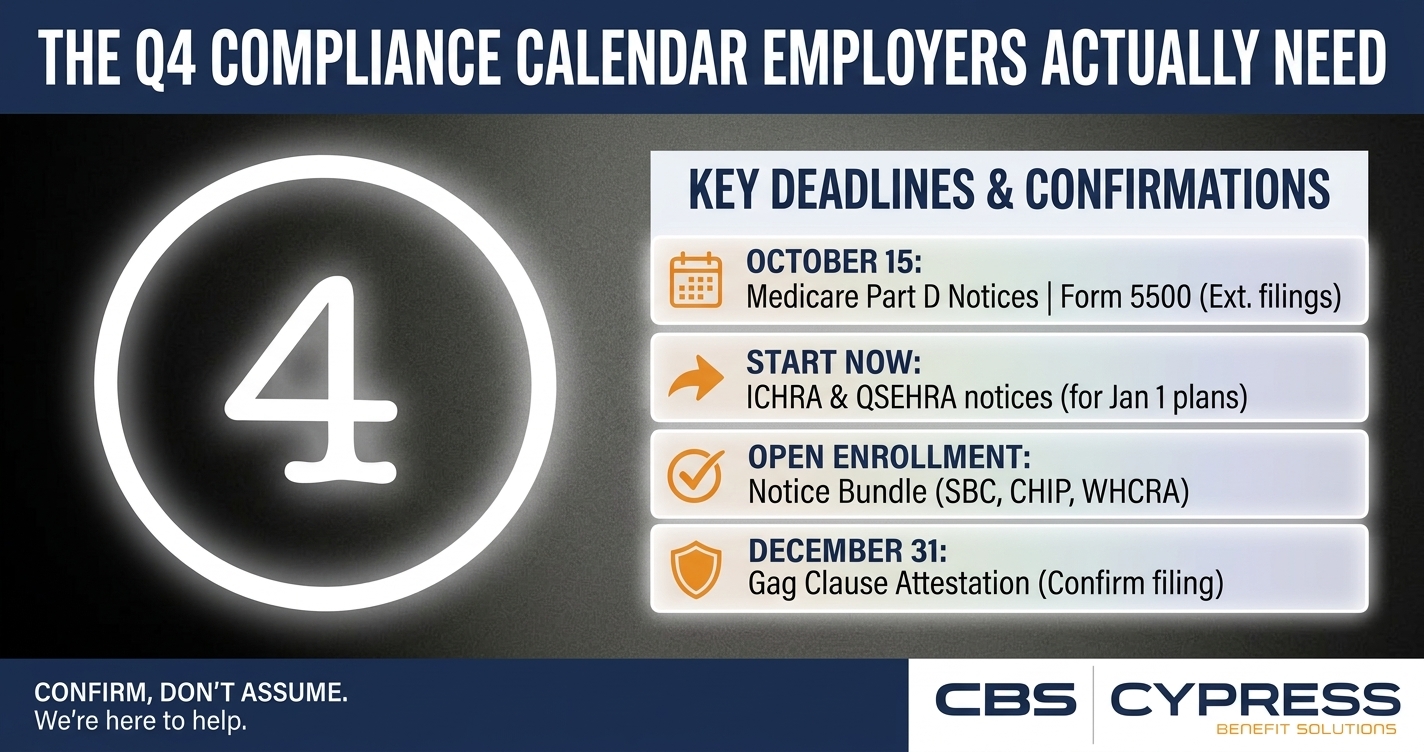
Medicare Part D Notices, Due October 15
Any employer offering a prescription drug plan must notify Medicare-eligible plan participants, including active employees, dependents, and retirees, whether that coverage is creditable or non-creditable compared to Medicare Part D. This notice has to go out before October 15, which is also the first day of Medicare’s own open enrollment window. The reason the timing matters so much is that a Medicare-eligible individual who goes without creditable coverage can face a permanent late enrollment penalty on their Medicare Part D premium, and the notice is often the only chance they have to make an informed decision before that window opens. Confirm that these notices went out, not just that they were supposed to.
Form 5500 Extended Filing Deadline, Also October 15
For calendar year plans that filed for the 2.5-month extension back in July, October 15 is the final deadline to file Form 5500. Missing this deadline carries real financial exposure, since penalties accrue on a daily basis and are not trivial. If your plan was on extension, this is worth a direct confirmation rather than an assumption that it has been handled.
ICHRA and QSEHRA Participant Notices
Employers rolling out an Individual Coverage Health Reimbursement Arrangement or a Qualified Small Employer Health Reimbursement Arrangement for the coming plan year are required to provide a written notice to eligible employees with enough lead time before the plan year begins. For a calendar year plan starting January 1, that notice needs to already be out the door or going out imminently. The notice has to explain how the arrangement works and, specifically for an ICHRA, how accepting it affects an employee’s eligibility for a premium tax credit on the individual marketplace. This is an easy one to let slip when attention is focused on open enrollment logistics.
What Belongs on the Calendar for the Rest of the Quarter
Open Enrollment Notice Bundle
Open enrollment is the natural moment to distribute the handful of annual notices required under federal law, including the Summary of Benefits and Coverage, the annual CHIP notice for employees in states with premium assistance programs, and the Women’s Health and Cancer Rights Act notice describing mastectomy-related benefits. None of these are new requirements, which is exactly why they tend to get treated as an afterthought. Bundling them cleanly into enrollment communications, rather than scattering them across separate emails employees are unlikely to open, meaningfully improves the odds they are actually read.
Gag Clause Prohibition Compliance Attestation, Due December 31
Since the Consolidated Appropriations Act took effect, group health plans have been required to attest annually that their contracts with carriers, administrators, and other service providers do not contain gag clauses restricting access to cost and quality data. Most fully insured employers rely on their carrier to file this attestation on the plan’s behalf, and most self-funded employers rely on their third party administrator. Relying on that is reasonable. Confirming it actually happened, in writing, before the December 31 deadline is the part that often gets skipped.
Preparing Now for Next Year’s ACA Reporting
The deadline to furnish Forms 1095-C to employees and file with the IRS does not land until early next year, but the data those forms require, including monthly coverage offers, employee contribution amounts, and affordability calculations, needs to be accurate for the entire year that is about to close. Starting that data review now, while Q4’s records are still fresh and correctable, is far less painful than reconstructing them under pressure in February.
Why This Quarter Deserves a Checklist, Not a Memory
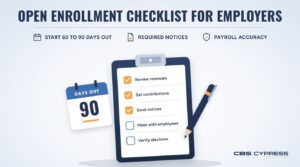
Every requirement above has a real consequence attached to it, whether that consequence falls on the employee in the form of a penalty, on the plan in the form of a fine, or on the employer in the form of a compliance gap discovered during an audit. None of them are difficult to satisfy. What makes Q4 genuinely risky is the number of deadlines compressed into a short window, combined with how easy it is to assume a vendor handled something that, in fact, fell through the cracks. A written checklist with a name attached to each item, confirmed rather than assumed, is the difference between a quiet quarter and an unpleasant surprise.
At Cypress Benefit Solutions, walking clients through exactly what is due, who is responsible for it, and confirming it actually happened is part of how we support a plan year rather than simply pricing one. If you want a second set of eyes on where your plan stands against this quarter’s deadlines, we would welcome the conversation. Reach out anytime.