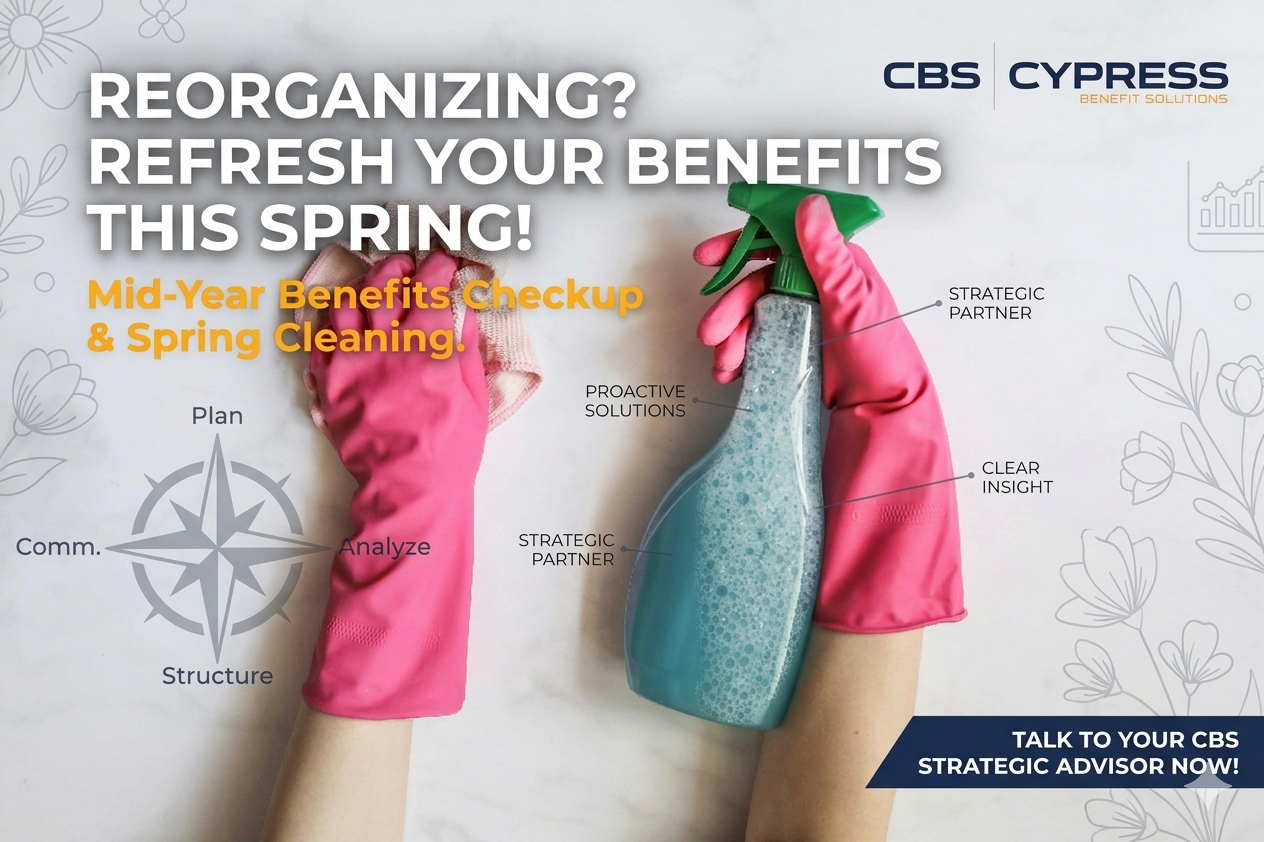
Spring has a way of prompting people to take stock of what is working and what has been sitting around longer than it should. The same instinct that drives people to clean out closets and reorganize garages is worth applying to your employee benefits program.
For most employers, benefits decisions get made at renewal time and then largely left alone until the next renewal rolls around. Some of those decisions age well. Others quietly stop making sense as the workforce changes, costs shift, and better options become available. Spring is a natural moment to step back and ask which category your current benefits are in.
This post walks through the benefits decisions most worth revisiting this time of year and gives you a practical starting point for each one.
Why Spring Is Actually a Smart Time for This
Most employer health plans renew on January 1 or July 1. If you are in the January renewal camp, you are now a few months removed from the pressure of renewal season, which means you have time to think clearly rather than reactively. If you are heading toward a July renewal, you are close enough that starting conversations now gives your broker time to do meaningful work before the deadline arrives.
Either way, the second quarter is one of the most underutilized windows in the benefits calendar. Employers who use it well tend to show up to their next renewal with better information, more options, and a clearer sense of what they are trying to accomplish. Those who wait until renewal pressure arrives tend to make faster, less considered decisions.
Think of this as your mid-year benefits checkup. Here is what to look at.
Revisit Your Plan Design
Plan design decisions made two or three years ago may no longer reflect the realities of your workforce or the market. A few specific areas worth examining:
Your Deductible and Out-of-Pocket Structure
Deductibles that seemed reasonable when they were set may now be creating real barriers to care for your employees. As we have covered in previous posts, employees who cannot afford their deductible tend to delay or skip care entirely, which drives up claims costs over time. If your deductible has crept up over several renewals as a cost-offset measure, it is worth asking whether that tradeoff is still making sense financially.
Your Network
Provider networks change. Hospitals and physician groups that were in-network when you selected your plan may have moved out of network since then, and employees may not know it until they receive a surprise bill. Spring is a good time to confirm that the network your plan uses still includes the providers your employees are most likely to use, particularly if you have seen any employee complaints about out-of-network charges in the past year.
Your Contribution Strategy
How you split the premium between employer and employee contribution has a direct impact on who enrolls in the plan and at what level. If your workforce demographics have shifted, if wage levels have changed, or if you have added employees in different life stages, your contribution strategy may need recalibration. A contribution structure that made sense for your workforce three years ago may be inadvertently pricing certain employees out of the coverage they need.
Take a Fresh Look at Your Ancillary Benefits
Health insurance tends to get all the attention, but the ancillary benefits sitting alongside it, dental, vision, life insurance, disability, and voluntary options, deserve their own review. These benefits are often set up and left alone for years, sometimes longer than the health plan.
Dental and Vision
Dental and vision plans have maximum benefit limits that often have not kept pace with actual costs. A dental plan with a $1,000 annual maximum may have made sense when it was set up but may now leave employees with significant out-of-pocket exposure on any meaningful dental work. Check whether your current maximums still reflect the actual cost of the services your employees are most likely to need.
Life Insurance Adequacy
Employer-provided life insurance is typically set as a flat amount or a multiple of salary. As your workforce grows and salaries increase, it is worth confirming that the coverage amounts in place are still appropriate. This is also a good time to remind employees to review their beneficiary designations, which are easy to set up and easy to forget to update after major life events like marriage, divorce, or the birth of a child.
Disability Coverage Gaps
Short-term and long-term disability coverage is one of the most underappreciated benefits in most packages. Many employees have no idea what their plan covers, how long benefits last, or what the elimination period is. If your current disability coverage has gaps, or if employees simply do not understand what they have, spring is a good time to address both.
Voluntary Benefits Worth Adding
If you have not recently reviewed the voluntary benefits available through your carrier or broker, now is a good time to ask what is available. Accident coverage, critical illness insurance, hospital indemnity plans, and identity protection are all options that employees can elect and pay for themselves, often at group rates that are meaningfully better than what they could access individually. Adding voluntary options costs the employer little to nothing and can meaningfully improve how employees perceive the overall package.
Review Your FSA, HSA, and HRA Utilization
Tax-advantaged accounts are one of the highest-value components of any benefits package, both for employers and employees. They are also consistently underutilized, often because employees do not fully understand how they work or how much they stand to save by using them.
Pull whatever utilization data is available on your FSA, HSA, or HRA and ask a few basic questions. What percentage of eligible employees are contributing? Are contribution levels appropriate given the cost-sharing structure of your health plan? Are employees leaving money on the table by not contributing to accounts that could offset their out-of-pocket costs?
If utilization is lower than it should be, the fix is usually communication rather than plan design. A simple mid-year reminder about how these accounts work and what they cover can meaningfully increase participation, particularly for employees who enrolled without fully understanding what they signed up for.
Assess Your Benefits Communication
This one is less tangible than the others but arguably just as important. How well do your employees actually understand the benefits they have? If the honest answer is that most of them only think about their benefits during open enrollment and when something goes wrong, that is a communication gap worth addressing.
Spring is a natural opportunity to send a benefits reminder that is not tied to enrollment. A simple communication highlighting a few underused benefits, explaining how to access telehealth, reminding employees about FSA balances or preventive care coverage, or introducing the EAP to employees who may have forgotten it exists can have a real impact on utilization and employee satisfaction without changing anything about the plan itself.
The employers who get the most value out of their benefits spend are not always the ones with the most generous plans. They are the ones whose employees actually understand and use what they have.
Check In on Your Broker Relationship
Spring is also a reasonable time to assess whether your benefits advisor relationship is delivering what it should. A strong benefits advisor is not someone who shows up at renewal, presents options, and disappears for eleven months. They are a year-round resource who proactively brings market information, helps you interpret your claims data, flags compliance requirements before they become problems, and helps you think strategically about where your benefits program is headed.
If the last time you heard from your broker was at your most recent renewal, that is worth noting. The spring window, away from the pressure of renewal season, is a good time to either deepen that relationship or have an honest conversation about whether a different advisory partnership might serve your company better.
Your Spring Benefits Checklist
To make this practical, here is a simple checklist to work through over the next few weeks:
- Review your current deductible and out-of-pocket structure against employee feedback and utilization data
- Confirm your provider network still includes the physicians and facilities your employees use most
- Revisit your employer and employee contribution split to ensure it still makes sense for your current workforce
- Check dental and vision maximum benefit limits against current cost benchmarks
- Review life insurance amounts and send a reminder to employees to update beneficiary designations
- Assess short-term and long-term disability coverage for gaps and communicate what is available
- Pull FSA, HSA, or HRA utilization data and send a mid-year reminder if participation is low
- Send a benefits communication that highlights underused resources like telehealth, the EAP, and preventive care
- Schedule a conversation with your benefits advisor to review where things stand and what, if anything, is worth addressing before the next renewal
None of these steps requires a full plan overhaul. Most of them are conversations and communications that can be completed quickly and produce meaningful results. The goal is simply to make sure that the benefits program you have invested in is actually working the way it should, for your employees and for your business.
If you would like a fresh set of eyes on any part of your benefits program this spring, that is exactly the kind of conversation we have with employers at Cypress Benefit Solutions. Reach out anytime and we would be glad to help.