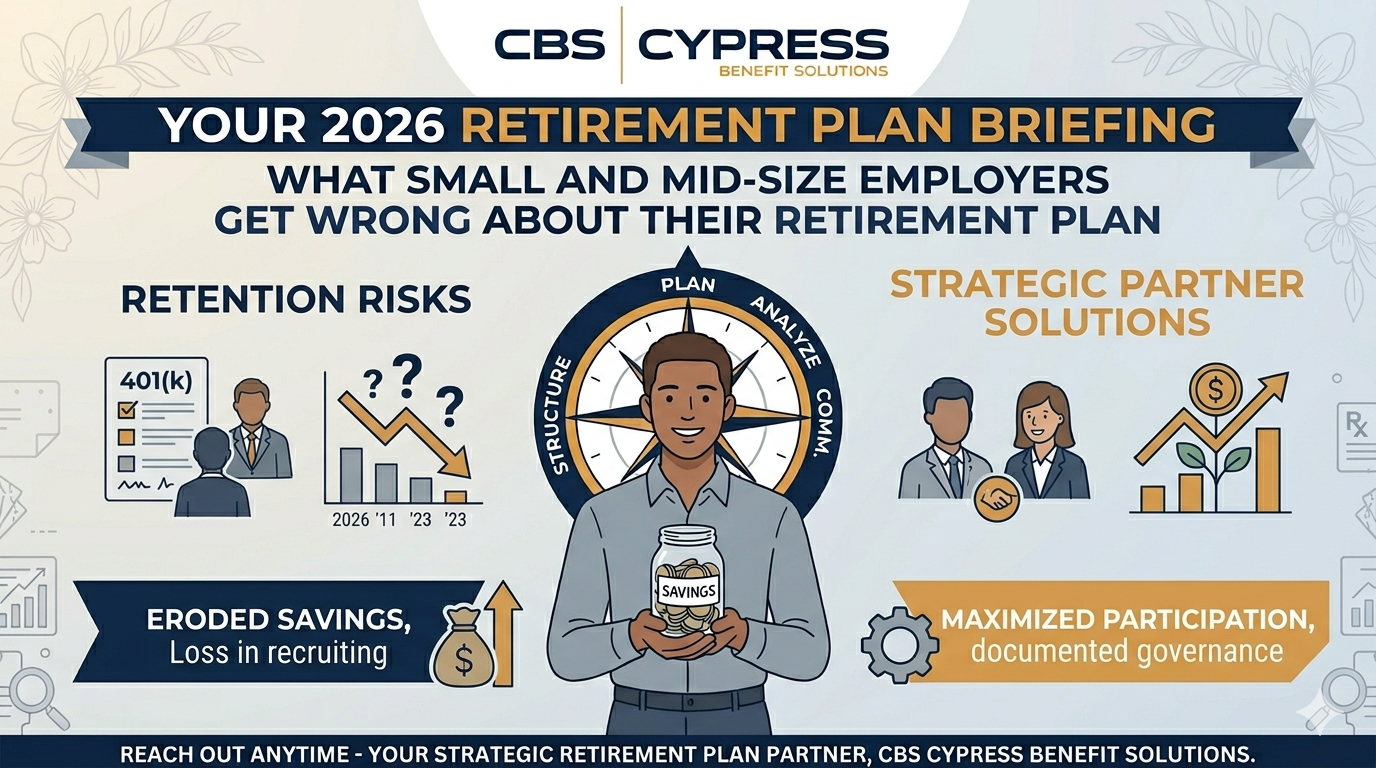
Offering a 401(k) plan is one of the best things a small or mid-size employer can do for their workforce. It signals that the company is serious about its employees’ long-term financial wellbeing, it provides a meaningful tax advantage for both the business and its people, and it is increasingly expected by the candidates employers are trying to attract.
But having a 401(k) plan and having a good 401(k) plan are two different things. A significant number of small and mid-size employers are offering retirement plans that are quietly underperforming, whether because of high fees, poor investment options, inadequate employer contributions, or simply a lack of attention since the plan was first set up.
This post walks through the most common mistakes employers make with their retirement plans, why those mistakes matter more than most employers realize, and what a well-managed plan actually looks like.
Mistake One: Setting It and Forgetting It
This is the most common mistake and the one that underlies many of the others. A retirement plan is not a one-time decision. It is an ongoing responsibility that requires regular attention to remain competitive, compliant, and cost-effective.
Many small and mid-size employers set up their 401(k) years ago, selected a provider and a fund lineup at the time, and have not meaningfully reviewed either since. In the meantime, the investment landscape has changed, plan fees have evolved, and the regulatory environment has added new requirements and fiduciary expectations that employers may not be aware of.
As a plan sponsor, an employer is a fiduciary. That means they have a legal obligation to act in the best interest of plan participants, which includes regularly reviewing investment options, monitoring fees, and ensuring the plan remains appropriate for the workforce it serves. Treating the plan as something that runs in the background without oversight is not just a missed opportunity. It is a fiduciary risk.
Mistake Two: Not Knowing What the Plan Actually Costs
Retirement plan fees are notoriously difficult to understand. They are often embedded in fund expense ratios, spread across multiple service providers, and disclosed in ways that make it hard to see the total cost at a glance. As a result, many employers genuinely do not know what their plan is costing their employees.
This matters for two reasons. First, high fees compound over time in a way that significantly erodes participant retirement savings. A difference of 0.5% in annual fees may sound small, but over a 30-year career it can reduce an employee’s retirement balance by tens of thousands of dollars. Second, as a fiduciary, the employer has a responsibility to ensure that plan fees are reasonable relative to the services being provided.
A plan fee benchmarking review, which a qualified retirement plan advisor can conduct, compares your plan’s total cost against comparable plans of similar size and structure. Many employers who go through this process for the first time discover they are paying significantly more than they should be, and that switching to a lower-cost structure or renegotiating with their current provider can produce meaningful savings for participants without any reduction in service quality.
Mistake Three: A Fund Lineup That Has Not Been Reviewed Recently
The investment options available in a 401(k) plan are not permanent fixtures. They require ongoing monitoring to ensure they continue to be appropriate, competitive, and well-managed. A fund that was a solid choice five years ago may have experienced a change in management, a drift in investment style, or a period of sustained underperformance that warrants replacement.
Most small and mid-size employer plans include a mix of actively managed funds and index funds across various asset classes, along with target-date funds that automatically adjust their allocation as an employee approaches retirement. The quality of these options varies significantly across providers, and the presence of a target-date fund series does not automatically mean the options are competitive or well-suited to your participant demographics.
A formal investment review, conducted at least annually, evaluates each fund in the lineup against relevant benchmarks and peer groups. Funds that consistently underperform their benchmark or peer group without a compelling explanation should be placed on a watch list and potentially replaced. This process protects both participants and the employer from the consequences of inattention.
Mistake Four: An Employer Match That Is Not Competitive
The employer match is one of the most visible and valued components of any 401(k) plan from an employee perspective. It is also one of the areas where small and mid-size employers most commonly fall behind their larger competitors.
The most common match structure among large employers is 50% of employee contributions up to 6% of salary, producing a maximum employer contribution of 3% of salary. Many larger employers have moved to more generous structures in recent years as competition for talent has increased. Small and mid-size employers who are offering a 25% match up to 4% of salary, or no match at all, may be creating a meaningful disadvantage in recruiting conversations without fully realizing it.
Match competitiveness should be evaluated in the context of the full compensation and benefits package, the industry the employer operates in, and the geographic market they are recruiting in. But the starting point is simply knowing where your match stands relative to what comparable employers are offering. Many employers have not had that conversation with their retirement plan advisor in years.
Mistake Five: Poor Employee Participation and Contribution Rates
A retirement plan’s value to employees is only realized if they actually participate in it and contribute at a level that will make a meaningful difference in their financial future. Low participation rates and low average contribution rates are a signal that something is not working, whether that is the plan design, the communication strategy, or both.
Auto-Enrollment Is One of the Most Effective Tools Available
Plans that automatically enroll eligible employees at a default contribution rate, rather than requiring employees to opt in, consistently produce higher participation rates. Research shows that auto-enrollment can increase participation from around 70% to over 90% in many plan populations. The SECURE 2.0 Act, passed in late 2022, now requires most new 401(k) plans established after December 29, 2022 to include auto-enrollment, which signals the direction the industry and regulators are moving.
Employers with existing plans that do not yet include auto-enrollment should evaluate whether adding it makes sense for their workforce. The impact on participation rates is typically significant and immediate.
Auto-Escalation Helps Employees Save More Over Time
Auto-escalation automatically increases an employee’s contribution rate by a set amount each year, typically 1%, up to a defined maximum. It is one of the most effective behavioral tools available to help employees gradually increase their savings rate without having to make an active decision each year. Combined with auto-enrollment, it is among the most impactful design changes a plan can make.
Mistake Six: Neglecting Employee Financial Education
Many employees, particularly younger workers and those who are new to investing, do not have the financial literacy needed to make informed decisions about their retirement savings. They may not understand how compound growth works, why the employer match is essentially free money they should not leave on the table, how to choose between investment options, or what a target-date fund actually does.
Employers who invest in financial education, whether through plan-sponsored materials, access to a financial advisor, or regular communication about retirement savings basics, tend to see higher participation rates, better contribution levels, and employees who feel more positively about their overall benefits package. Financial wellness is increasingly recognized as a meaningful component of employee wellbeing, and the retirement plan is a natural vehicle for addressing it.
Mistake Seven: Not Having a Qualified Retirement Plan Advisor
Many small and mid-size employers rely entirely on their recordkeeper or third-party administrator for guidance on their retirement plan. While these providers play an important role in plan administration, they are not the same as an independent retirement plan advisor who is acting as a fiduciary on behalf of the employer and the plan participants.
A qualified retirement plan advisor brings independent expertise to investment selection and monitoring, fee benchmarking, plan design recommendations, compliance oversight, and employee education. They serve as a check on the plan’s overall health and help the employer meet their fiduciary obligations in a documented, defensible way. For small and mid-size employers who may not have in-house expertise in retirement plan management, this kind of independent advisory relationship is not a luxury. It is a fundamental component of responsible plan governance.
What a Well-Managed Retirement Plan Looks Like
Pulling all of this together, a well-managed retirement plan for a small or mid-size employer has a few defining characteristics. It is reviewed formally at least once a year, covering both the investment lineup and overall plan fees. It has a match structure that is competitive for the employer’s industry and market. It includes auto-enrollment and auto-escalation features that maximize participation and savings rates. It supports employees with financial education resources that help them make informed decisions. And it is supported by an independent advisor who is actively engaged year-round, not just when a problem arises.
None of this requires a large or complex organization to achieve. It requires intentionality and the right advisory relationship.
How Cypress Benefit Solutions Approaches Retirement Plan Consulting
At Cypress Benefit Solutions, retirement plan consulting is a core part of what we do. We work with small and mid-size employers to evaluate their current plan, benchmark fees and investment performance against relevant peers, identify design improvements that can increase participation and savings outcomes, and ensure that employers are meeting their fiduciary responsibilities in a documented and defensible way.
If your 401(k) plan has not been formally reviewed in the past year, or if you are not entirely sure how your fees, match structure, and investment lineup compare to the market, that is a conversation worth having. Retirement plan quality is increasingly a factor in how employees evaluate their total compensation, and the employers who stay ahead of it tend to attract and retain better talent as a result.
Reach out anytime if you would like to start with a no-obligation review of your current plan. We would be glad to take a look.