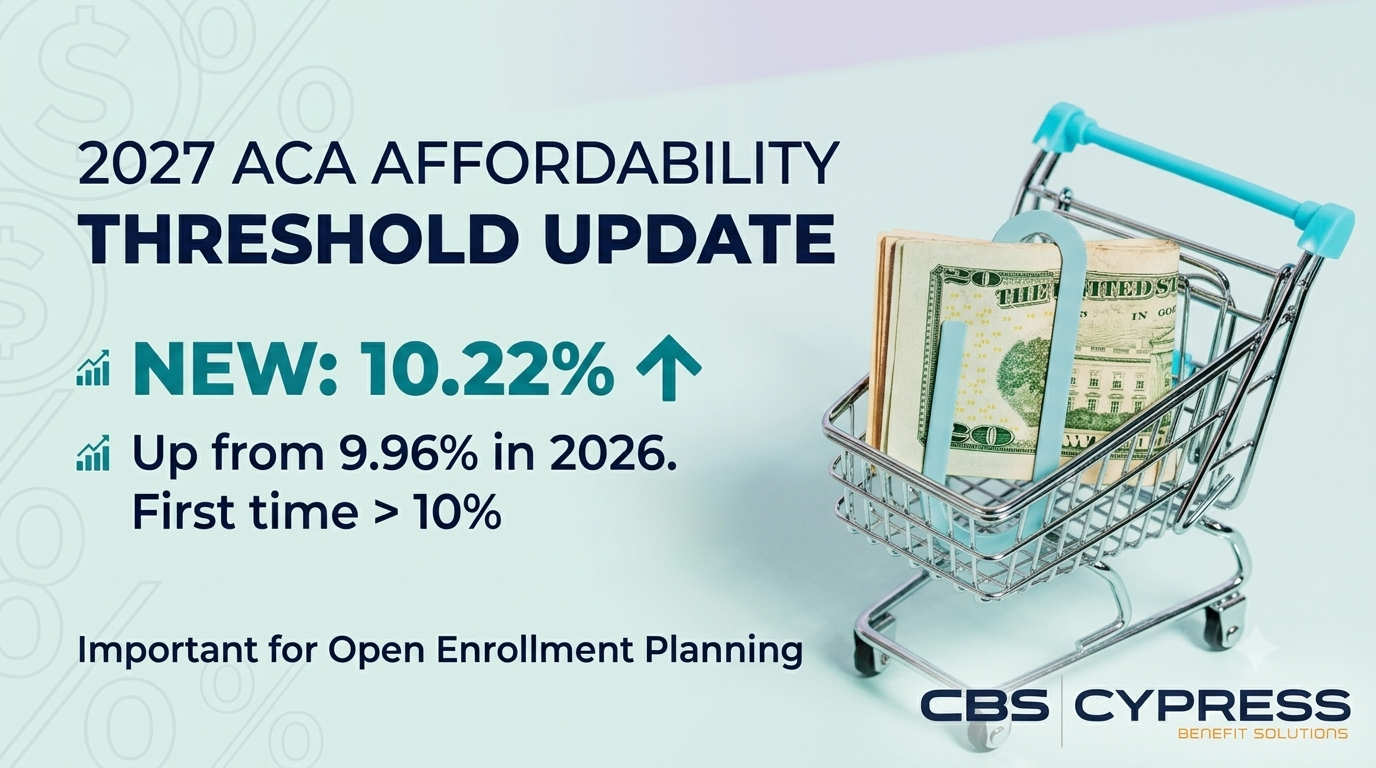
On July 21, 2026, the IRS released Revenue Procedure 2026-26, which sets the ACA affordability percentage for plan years beginning in 2027 at 10.22%. That is up from 9.96% in 2026 and marks the first time the affordability threshold has exceeded 10% since the ACA was enacted. It is also the highest the percentage has ever been.
For applicable large employers subject to the ACA employer mandate, this update is directly relevant to how employee contribution amounts are set heading into open enrollment. Understanding what the new threshold means, how it applies, and what employers need to do before their 2027 plan year begins is the subject of this post.
What the ACA Affordability Threshold Actually Is
The ACA employer shared responsibility provisions require applicable large employers, generally defined as employers with 50 or more full-time equivalent employees, to offer full-time employees minimum essential coverage that meets two standards: minimum value and affordability. Coverage that fails either standard can expose the employer to employer shared responsibility penalties, commonly called the employer mandate penalty or the pay-or-play penalty, if a full-time employee obtains subsidized Marketplace coverage instead.
Affordability is defined by whether the employee’s required contribution for self-only coverage under the employer’s lowest-cost minimum value plan exceeds a defined percentage of the employee’s household income. Because employers typically do not know each employee’s household income, the IRS provides three safe harbors that allow employers to determine affordability using information they do have available.
The affordability percentage itself is adjusted annually by the IRS based on premium and income growth trends. For 2027, that percentage is 10.22%. What this means in practice is that an employer’s coverage is considered affordable if the employee’s required contribution for self-only coverage does not exceed 10.22% of the employee’s household income, or the applicable safe harbor equivalent.
The Three Affordability Safe Harbors
Because most employers do not have reliable access to their employees’ actual household income, the IRS permits use of one of three safe harbors to determine whether coverage is affordable. Employers may use different safe harbors for different categories of employees but must apply the chosen safe harbor consistently within each category.
The W-2 Safe Harbor
Under the W-2 safe harbor, coverage is affordable if the employee’s required contribution for the year does not exceed 10.22% of the employee’s W-2 wages as reported in Box 1 for that calendar year. Because W-2 wages are not known until after the year ends, this safe harbor is typically used prospectively by setting employee contributions based on the prior year’s W-2 wages or the current year’s anticipated wages. It is the most complex of the three safe harbors to administer but can be the most favorable for employers with higher-wage workforces.
The Rate of Pay Safe Harbor
Under the rate of pay safe harbor, coverage is affordable if the employee’s required contribution does not exceed 10.22% of an amount equal to 130 hours multiplied by the employee’s hourly rate of pay, or the employee’s monthly salary for salaried employees. For hourly employees this means multiplying the lowest hourly rate by 130 to get the monthly equivalent, then applying the 10.22% threshold to that amount. This safe harbor is generally the most straightforward to apply for employers with hourly workforces.
The Federal Poverty Line Safe Harbor
Under the federal poverty line safe harbor, coverage is affordable if the employee’s required monthly contribution for self-only coverage does not exceed 10.22% of the federal poverty line for a single individual, divided by twelve. For calendar year 2027 plans, this calculation uses the 2026 federal poverty level of $15,960 because the updated 2027 federal poverty guidelines will not be published until after the 2027 plan year has already begun.
The math for the 2027 FPL safe harbor is as follows: $15,960 multiplied by 10.22% divided by twelve equals $135.926 per month. The cautious approach is to set the monthly FPL safe harbor contribution at $135.92 rather than rounding up to $135.93, because setting the contribution at or below the threshold is what satisfies the safe harbor. Any amount above $135.92 per month for the lowest-cost minimum value plan would technically exceed the safe harbor ceiling.
The FPL safe harbor is the simplest to administer because the calculation is the same for every employee regardless of wages or hours. For employers looking for a clean, defensible approach to affordability compliance, it is often the most practical choice.
Why This Increase Matters for Open Enrollment Planning
A higher affordability percentage gives employers more financial flexibility when setting employee contribution amounts. If the 2026 threshold was 9.96% and the 2027 threshold is 10.22%, an employer using the FPL safe harbor can charge employees up to $135.92 per month in 2027 rather than the $131.40 ceiling that applied in 2026 under the prior calculation. That is an increase of $4.52 per month, or roughly $54 per year, in the maximum employee contribution that satisfies the FPL safe harbor.
For employers using the rate of pay or W-2 safe harbors, the increase in the percentage similarly allows for slightly higher employee contributions before the affordability threshold is breached. In a year when carrier renewal increases are running in the range of seven to twenty percent in some markets, the additional flexibility provided by the higher threshold gives employers a modest amount of room to adjust contribution strategy without triggering affordability concerns.
It is important to be clear about what this flexibility does and does not represent. A higher affordability threshold does not reduce the underlying obligation to offer coverage. It does not change the minimum value standard. It does not affect the requirement to offer coverage to at least 95% of full-time employees and their dependent children. What it does is give employers slightly more room to set employee contribution levels before crossing the line that triggers affordability-related employer shared responsibility exposure.
The 2027 Employer Shared Responsibility Penalties
The 2027 ACA update also includes significant increases to the employer shared responsibility penalty amounts. These penalties apply when an applicable large employer fails to offer affordable minimum value coverage and a full-time employee obtains subsidized Marketplace coverage instead.
The penalties for 2027 increased by approximately 13.2% from the 2026 amounts, continuing a trend of substantial year-over-year penalty growth. This makes getting the affordability calculation right increasingly consequential. The IRS continues to actively enforce the employer mandate through Letter 226-J assessments and Letter 5699 non-filer notices, and the enforcement posture has not softened. Employers who are not confident their contribution strategy satisfies an applicable safe harbor should address that before their 2027 plan year begins, not after an IRS notice arrives.
Who Needs to Pay Attention to This Update
The ACA affordability provisions apply specifically to applicable large employers, defined as employers who employed an average of at least 50 full-time equivalent employees during the prior calendar year. Employers below this threshold are not subject to the employer mandate and the affordability threshold does not apply to them in the same way.
For employers who are applicable large employers, the 2027 affordability threshold is relevant regardless of whether you are on a fully insured or self-funded plan. The affordability determination is about what employees are required to contribute, not about how the plan is funded. Self-funded employers are subject to the same affordability requirements as fully insured employers.
Non-calendar-year plans should note that the 10.22% threshold applies to plan years beginning in 2027. A plan year that began in 2026 and has not yet renewed will continue using the 2026 affordability percentage of 9.96% until the 2027 plan year begins. The applicable percentage is determined by when the plan year starts, not by the calendar year.
Action Items Before Open Enrollment
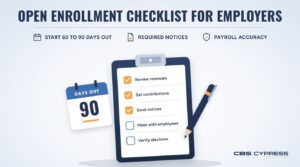
With open enrollment season approaching, here is a practical checklist of what applicable large employers should be doing in light of the 2027 affordability update.
- Confirm your ALE status for the 2027 plan year based on your 2026 full-time equivalent employee count
- Identify which affordability safe harbor you are using and verify that your 2027 employee contribution amounts satisfy that safe harbor under the 10.22% threshold
- If using the FPL safe harbor, confirm the monthly employee contribution for self-only coverage under your lowest-cost minimum value plan does not exceed $135.92
- If using the rate of pay safe harbor, recalculate the threshold for your lowest-paid full-time employees using the updated 10.22% percentage
- Review whether the 0.26 percentage point increase in the affordability threshold changes any employee contribution decisions you were planning for 2027
- Confirm that your plan still meets the minimum value standard, meaning it covers at least 60% of the actuarial value of covered benefits
- Ensure your open enrollment materials accurately reflect the employee contribution amounts for the 2027 plan year
- Confirm that your Forms 1094-C and 1095-C for prior plan years have been filed and accepted by the IRS and address any outstanding issues before the 2027 plan year begins
- If you received an IRS Letter 226-J or Letter 5699 related to prior year filings, engage your benefits advisor and legal counsel to address it before the 2027 open enrollment
A Note on the Broader Compliance Picture
The annual affordability percentage update is one piece of a larger ACA compliance picture that applicable large employers need to stay current on. Offer of coverage requirements, minimum value standards, reporting obligations under Sections 6055 and 6056, and the interaction between ICHRA arrangements and employee Marketplace eligibility are all areas where the rules are specific, the enforcement is active, and the consequences of getting it wrong have grown more significant as penalty amounts have increased.
A higher affordability threshold is helpful context for open enrollment planning. It is not a signal that ACA compliance requires less attention. If anything, the trend toward higher penalty amounts and continued IRS enforcement activity suggests that applicable large employers should be more deliberate about their compliance posture heading into 2027, not less.
At Cypress Benefit Solutions, keeping employers current on ACA updates like this one and helping them translate compliance requirements into practical decisions is part of the year-round advisory work we do. If you have questions about how the 2027 affordability threshold applies to your specific contribution strategy, or if you want to confirm that your approach satisfies an applicable safe harbor before open enrollment materials go out, reach out anytime. We would be glad to work through it with you.