There is a distinction that does not get nearly enough attention in employer benefits conversations: the difference between having health insurance and actually being able to use it.
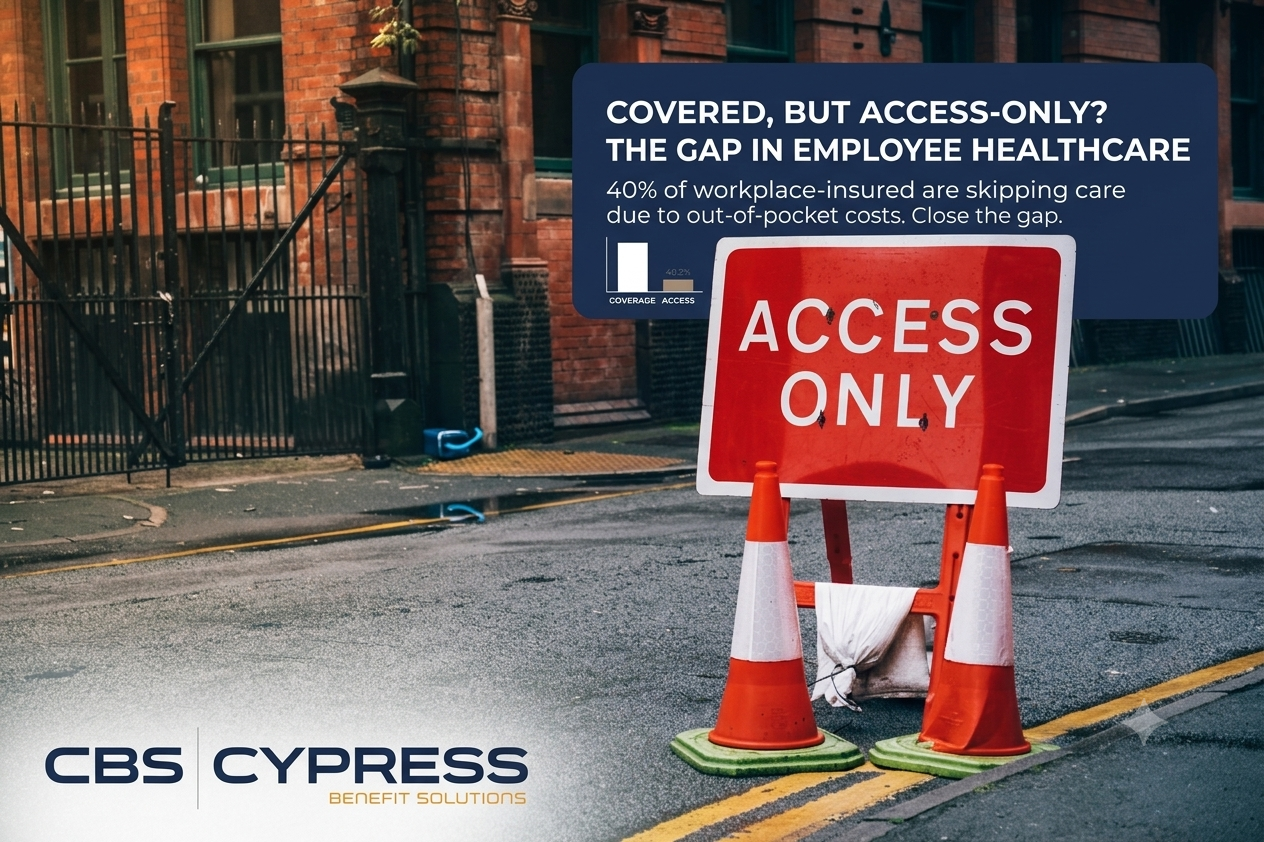
Most employers assume that once their employees are enrolled in a health plan, the access problem is solved. The data says otherwise. According to Paytient’s recent Hidden Lives of Workplace-Insured Americans report, 40% of people with employer-sponsored health insurance are still delaying or skipping care because of out-of-pocket costs. Among those who are waiting, 38% say their health is actively getting worse while they do.
These are not uninsured Americans struggling to access the healthcare system. These are your employees, enrolled in the plan you are paying tens of thousands of dollars a year to provide, choosing not to use it because they cannot afford what it asks them to pay out of pocket.
That gap between coverage and access is a workforce problem, a financial problem, and increasingly a competitive problem for employers who want to attract and retain strong people. This post breaks down what is driving it, what it actually costs employers, and what practical approaches are available to close it.
The Numbers Behind the Problem
The Paytient research paints a specific and sobering picture of what is happening inside employer-sponsored health plans right now. It is worth sitting with these numbers before moving to solutions.
Forty percent of employer-insured Americans are delaying or skipping care due to out-of-pocket costs. That is not a fringe phenomenon. In a company of 100 employees, that is roughly 40 people making decisions to put off care they know they need.
Fifty-six percent of workplace-insured Americans are either delaying filling prescriptions, splitting pills to make them last, or simply not filling them at all. This is one of the clearest signals that cost barriers are affecting health outcomes in real time, not just at the margins.
Forty-one percent are reaching for high-interest credit cards to cover medical bills. Forty percent are draining their savings. These are not employees who are indifferent to their health. They are employees who are making financially desperate decisions to access care and carrying the stress of that into work with them every day.
The productivity data makes the business case explicit. Employees who are forced to delay care lose an average of 6.3 hours of productivity per week due to distractions related to their health situation. They are physically present but not mentally engaged. That is a direct and measurable cost to the employer that does not show up in the health plan budget but absolutely shows up in the business.
Why This Is Happening Even With Good Coverage
The deductible is the most significant driver of the coverage-versus-access gap. As we have discussed in previous posts, employer health plans have increasingly absorbed annual premium increases by raising deductibles and shifting more cost sharing to employees. The logic is straightforward: higher deductibles reduce the employer’s premium contribution. The unintended consequence is that employees who face a $1,500 or $2,500 deductible before their coverage meaningfully kicks in often make the same decision as someone with no insurance at all. They wait. They skip. They hope the problem resolves on its own.
The ACA out-of-pocket maximum for 2027 just increased to $12,000 for self-only coverage, as we covered last week. That is the theoretical ceiling of what an employee can be asked to pay in a single plan year for in-network care. For a family earning $65,000 or $75,000 a year, a $12,000 exposure is not a backstop. It is a financial catastrophe. Even amounts well below that ceiling, a $3,000 deductible, a $500 ER copay, a $200 specialist visit, create decision points where employees choose between their health and their financial stability.
The solution is not simply to lower deductibles across the board. That drives premium costs up and creates its own set of affordability problems. The real answer is more nuanced and requires thinking about the employee’s experience of the plan, not just its design on paper.
How Employers Can Start to Close the Gap
There is no single fix for the coverage-versus-access problem, but there are a meaningful set of tools and approaches that employers can deploy, often without dramatically increasing their overall benefits spend.
Evaluate Your Plan Design Through the Lens of Affordability
The first step is an honest assessment of what your plan actually asks employees to pay before insurance provides meaningful relief. This means looking at the deductible, the copay structure, the coinsurance rates, and the out-of-pocket maximum together rather than in isolation. A plan with a low premium and a $3,000 deductible may look affordable from the employer’s perspective but create significant barriers to care for employees who live paycheck to paycheck.
Asking the question, can the employees who need this plan the most actually afford to use it, is a different question than asking whether the premium is competitive. Both matter. Most employer plan reviews focus heavily on the first and underweight the second.
Make Sure Preventive Care Is Clearly Communicated as Free
Most ACA-compliant plans cover preventive services at 100% with no cost sharing. Annual physicals, screenings, vaccinations, and a range of other preventive services cost the employee nothing. The problem is that many employees do not know this or do not trust it until they have actually used the benefit without receiving a bill.
Employers who actively communicate that preventive care is free, repeatedly and in plain language, see meaningfully higher utilization rates. This is a communication investment that costs nothing and directly addresses one of the most common reasons employees delay routine care.
Promote Telehealth as a Low-Barrier Access Point
Telehealth visits typically carry lower cost sharing than in-person visits and remove the practical barriers of scheduling, transportation, and time off work that prevent many employees from seeking care. If your plan includes telehealth coverage, making sure every employee knows how to access it and understands the cost structure is one of the highest-return communication investments available.
For employees who are skipping care because a copay feels unaffordable or because getting to a doctor’s office during business hours is genuinely difficult, telehealth can be the difference between getting care and not getting it.
Consider Healthcare Repayment Benefits
An emerging category of employer benefit worth understanding is the healthcare repayment benefit, sometimes called a health payment plan or medical payment benefit. Rather than requiring employees to pay large out-of-pocket costs all at once, these programs give employees a way to spread healthcare expenses over time through interest-free installment arrangements.
The concept is straightforward. When an employee faces a medical expense they cannot cover immediately, instead of putting it on a high-interest credit card or skipping the care entirely, they access a payment arrangement through their employer’s benefit program that allows them to repay the cost over several months at no interest. The employer typically pays a per-employee per-month fee for access to the program, similar to how other voluntary benefits are structured.
The impact data on these programs is meaningful. Paytient’s research found that 78% of users accessed care they would have otherwise skipped or delayed. For employers, the downstream benefit is that employees who get care when they need it tend to have better health outcomes, fewer productivity disruptions, and lower long-term claims costs as conditions are addressed before they escalate.
Healthcare repayment benefits are not a replacement for a well-designed health plan. They are a complement to it that addresses the gap between what the plan covers and what the employee can actually afford to pay in the moment care is needed.
Review Your HSA or FSA Structure and Communication
Tax-advantaged accounts like HSAs and FSAs exist precisely to help employees manage out-of-pocket costs with pre-tax dollars. The problem is that they are consistently underutilized, often because employees do not fully understand how they work or have not contributed at a level that provides meaningful protection against larger expenses.
Employers who make HSA contributions on behalf of employees, even modest ones, and who communicate clearly about how these accounts work in relation to the deductible tend to see higher utilization of the accounts and better employee financial preparation for out-of-pocket costs. Connecting the dots between the deductible, the HSA, and the out-of-pocket maximum in plain language is a communication investment that pays real dividends in employee experience and care-seeking behavior.
The Bigger Picture: Benefits as a Workforce Performance Strategy
The coverage-versus-access gap is not just a benefits design problem. It is a workforce performance problem. Employees who are managing untreated health conditions, carrying medical debt, or making financially desperate decisions to access care are employees who are distracted, less productive, and more likely to leave for an employer whose benefits actually work for them.
The most forward-thinking employers are starting to evaluate their benefits not just by how much they cost but by how well they function for the employees who depend on them. That means asking whether employees are actually using the plan, whether the cost sharing structure creates barriers to care, and whether there are affordable additions to the benefit package that could close the access gap without dramatically increasing overall spend.
At Cypress Benefit Solutions, this is exactly the kind of conversation we believe every employer deserves to have with their benefits advisor. Understanding whether your plan is working for your employees, not just on paper but in practice, is one of the most important questions in benefits management right now. If you are not sure of the answer, we would welcome the opportunity to look at it together. Reach out anytime.