Every employer who has ever raised a deductible, changed carriers, reduced a benefit, or restructured a contribution split knows what comes next. Confusion. Frustration. Employees who feel like something was taken from them without adequate explanation. And in the worst cases, a quiet erosion of trust that shows up in engagement scores and exit interviews months later.
Benefits changes are sometimes necessary. Costs go up. Plan designs need to evolve. Carriers change. Contribution structures that made sense three years ago may no longer be sustainable. These are business realities that most employees, when given the full picture, can understand and accept. The problem is that most employers do not give them the full picture. They announce the change, explain the mechanics, and move on. What they skip is the context, the reasoning, and the genuine acknowledgment that the change affects real people in real ways.
How you communicate benefits changes matters almost as much as what the changes are. This post walks through what good benefits change communication looks like, where employers most commonly fall short, and how to approach open enrollment this year in a way that builds trust rather than erodes it.
Why Benefits Changes Hit Differently Than Other Business Decisions
Benefits are personal in a way that most other employer decisions are not. A change to a software system or an office policy lands differently than a change to the health plan an employee depends on to manage their family’s medical care. Benefits touch on things that matter deeply: whether an employee can afford to take their child to the doctor, whether a spouse’s medication is still covered, whether the out-of-pocket costs they budgeted for last year are still accurate.
When benefits change and employees feel blindsided or under-informed, the emotional response is rarely indifference. It tends to be a combination of anxiety about what the change means for their family, frustration that it was not explained clearly, and a sense that the employer prioritized cost savings over employee wellbeing. Whether or not that interpretation is accurate, it is a predictable outcome of poor communication and it is one that employers have significant control over.
The goal of good benefits change communication is not to make employees feel good about changes they would rather not have. It is to give them enough context, clarity, and respect to understand why the change is happening, what it means for them specifically, and what they can do in response. That is a very achievable standard and it makes a meaningful difference in how changes land.
The Most Common Communication Mistakes
Before getting to what good looks like it helps to name the patterns that most commonly undermine trust during benefits changes.
Announcing the Change Without Explaining the Why
The most frequent mistake is treating a benefits change as a logistics announcement rather than a business decision that deserves context. Telling employees that their deductible is going from $1,500 to $2,000 next year without explaining what drove that decision leaves them to fill in the gap themselves. The story they tell in the absence of information is almost always worse than the actual story. They assume the company is cutting corners, prioritizing profit over people, or simply does not care about the impact on employees. Providing context, even imperfect context, almost always produces a better outcome than leaving a vacuum.
Burying the News in Dense Documentation
Open enrollment packets are not a communication strategy. A 40-page summary plan description delivered during a busy time of year, with the expectation that employees will read it carefully and identify what has changed, is not how most people process important information. When significant changes are buried in documents rather than surfaced and explained directly, employees either miss them entirely or discover them at the worst possible moment, when they are already at the doctor’s office or pharmacy dealing with the consequences.
Communicating Only Once
A single email or a single open enrollment meeting is not enough to ensure that employees understand changes to their benefits. People are busy, inboxes are crowded, and open enrollment timing often competes with quarter-end work demands and personal obligations. Important changes need to be communicated multiple times across multiple channels before the enrollment deadline arrives. Employers who communicate once and consider the job done routinely discover that a significant portion of their workforce was not paying attention.
Using Jargon Without Translation
Benefits terminology is genuinely confusing to many employees. Deductible, out-of-pocket maximum, coinsurance, formulary, prior authorization, in-network versus out-of-network. These terms have precise meanings that matter enormously in practice, but they are not intuitive to employees who do not spend their days thinking about health plan design. When communication relies on jargon without plain-language explanation, employees tune out or make decisions based on incomplete understanding. Neither outcome serves the employer or the employee well.
Failing to Acknowledge the Impact
One of the most trust-damaging communication failures is pretending that a change that costs employees more money is neutral or positive. Employees are not naive. When an employer presents a significant deductible increase as a minor adjustment or frames a reduction in coverage as an enhancement, the credibility damage is immediate and lasting. Employees respect honesty. Acknowledging that a change is difficult while explaining why it was necessary is almost always a stronger position than spin.
What Good Benefits Change Communication Looks Like
The standard for good communication is not complicated, but it does require intentionality and more lead time than most employers give themselves.
Start With the Why
Before explaining what is changing, explain why. This does not mean sharing every detail of the renewal negotiation or disclosing proprietary cost data. It means giving employees enough context to understand the forces at work. Healthcare costs are rising faster than most other business expenses. Carrier negotiations produced a result that required some plan design adjustments. The company evaluated multiple options and the current approach represents the best balance of cost and coverage it was able to achieve. These are honest, accessible explanations that respect employees as adults capable of understanding business realities.
Employers who share the why tend to find that employees are more understanding of changes they find difficult than employers expect. Most people recognize that healthcare cost increases are not unique to their employer. What they need is confirmation that the employer took the situation seriously and made thoughtful decisions rather than simply passing cost along without consideration.
Surface the Changes Directly and Specifically
Do not make employees hunt for what changed. Prepare a clear, specific summary that identifies exactly what is different from the prior year, what the financial impact might look like for a typical employee, and what employees should pay particular attention to during enrollment. If the deductible is increasing, say so clearly and say by how much. If a carrier is changing, explain what that means for network access and whether employees need to take any action to ensure continuity of care. If a benefit is being added or expanded, highlight that clearly as well.
The goal is to ensure that no employee gets to open enrollment and says they had no idea something had changed. Whether they agree with the change is a separate question. Awareness is the baseline.
Use Multiple Channels and Multiple Touchpoints
A strong open enrollment communication plan uses more than one channel and more than one touchpoint between the announcement of changes and the enrollment deadline. This might look like an initial email from leadership explaining what is changing and why, followed by a department or team meeting where managers can answer questions, followed by a written summary employees can reference, followed by a reminder as the deadline approaches.
Not every employee engages with every channel. Some employees read every email carefully. Others respond better to a conversation with their manager. Some need a document they can take home and review with their spouse or partner. Layering communication across formats and timing points dramatically increases the likelihood that the information actually reaches everyone who needs it.
Make It Easy to Ask Questions
Employees who have questions about benefits changes are far less likely to become frustrated or anxious if there is a clear, accessible way to get answers. Whether that is a dedicated HR contact, a benefits hotline, a scheduled Q and A session, or simply a stated invitation to reach out directly, making it easy to ask questions reduces the rumor mill effect that often accompanies significant benefits changes.
It is also worth briefing managers on the changes before they are communicated broadly to employees. Managers are frequently the first person an employee goes to with a benefits question and a manager who is caught off guard or gives inaccurate information compounds the communication problem significantly.
Acknowledge the Difficulty Honestly
If the changes you are communicating are genuinely difficult for employees, say so. Acknowledging that a deductible increase puts more financial pressure on employees, that you understand it is not the news anyone wanted, and that the decision was made carefully after evaluating the alternatives is not a sign of weakness. It is a sign of leadership. Employees who feel acknowledged and respected in difficult moments tend to extend considerably more benefit of the doubt than those who feel managed or manipulated.
This does not mean dwelling on the difficulty or making the communication feel like an apology. It means being human about it and moving forward with clarity and confidence about the path ahead.
A Note on Timing
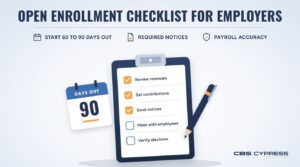
Good benefits change communication requires lead time that most employers do not give themselves. If your open enrollment begins in October for a January plan year, employees should be hearing about significant changes in September, not the week enrollment opens. Earlier communication gives employees time to process, ask questions, and make informed decisions rather than rushing through enrollment under deadline pressure.
It also gives the employer time to correct misunderstandings before they harden into grievances. The earlier communication goes out, the more time there is to respond to employee questions and concerns in a way that demonstrates genuine care for how the changes land.
How Cypress Benefit Solutions Supports This Process
Benefits change communication is an area where having an experienced advisor in your corner makes a real difference. We help employers think through not just what is changing and why, but how to present those changes in a way that employees can understand and accept. That includes drafting plain-language communication materials, preparing managers to answer common questions, and designing an enrollment communication timeline that gives every employee the information they need before the deadline arrives.
If you are heading into an open enrollment this fall with changes you are not sure how to communicate, or if you want a second set of eyes on your communication plan before it goes out, we would be glad to help. Reach out anytime.