There is a version of the employee wellbeing conversation that sounds like a feel-good initiative with a soft return on investment. Wellness programs, mental health resources, flexible schedules, and benefits that go beyond the basics are easy to categorize as nice-to-haves rather than business necessities. That framing has allowed a lot of employers to underprice the connection between how their employees are doing and how their business is performing.
The data tells a different story. Employee wellbeing is not a peripheral concern that sits alongside business performance. It is one of its primary drivers. The research connecting physical health, mental health, financial stress, and employee engagement to measurable business outcomes including productivity, absenteeism, turnover, and healthcare costs has grown substantially over the past decade. And the picture it paints is consistent: employers who invest meaningfully in the wellbeing of their workforce tend to outperform those who do not, not just on employee satisfaction metrics but on the financial measures that matter most to owners and CFOs.
This post is an attempt to make that connection concrete rather than abstract. It covers what the research actually shows across the major dimensions of employee wellbeing, how those dimensions connect to specific business outcomes, and what employers can do to move from awareness to action.
Defining Wellbeing: It Is More Than Physical Health
When employers think about employee wellbeing, the first association is usually physical health: whether employees are getting preventive care, managing chronic conditions, and using their health benefits appropriately. Physical health matters enormously and we have covered it in depth in previous posts. But wellbeing is a broader concept that encompasses at least four distinct dimensions, each of which connects to business outcomes in its own way.
Physical wellbeing is the dimension most directly connected to healthcare costs and claims experience. Employees who maintain their physical health through preventive care, chronic condition management, and healthy behaviors generate lower claims costs over time and experience fewer health-related productivity disruptions. The relationship between physical health and healthcare cost is direct and well-documented.
Mental and emotional wellbeing has become one of the most significant and fastest-growing areas of employer concern. Anxiety, depression, burnout, and stress-related conditions affect a substantial portion of the working population and carry business costs that are often larger and less visible than physical health costs. Mental health conditions reduce productivity, increase absenteeism, contribute to turnover, and can escalate into serious health events that generate significant claims when left unaddressed.
Financial wellbeing is an area that receives less attention than it deserves in most employer benefits conversations. Employees who are managing significant financial stress, including medical debt, inadequate emergency savings, or uncertainty about retirement, carry that stress into work with them every day. As we covered in a recent post on healthcare affordability, employees facing financial pressure related to healthcare costs lose an average of 6.3 hours of productivity per week due to distraction. Financial wellbeing is not separate from work performance. It is woven through it.
Social and relational wellbeing, including the quality of relationships employees have with their colleagues, managers, and the organization as a whole, is the dimension that is most often treated as soft but has some of the most robust connections to business outcomes. Employees who feel connected, valued, and part of something meaningful are more engaged, more productive, more innovative, and significantly less likely to leave. The research on belonging and engagement consistently shows that the social dimension of work is not incidental to performance. It is central to it.
The Business Case: What the Research Shows
Each of these dimensions of wellbeing connects to business outcomes through mechanisms that are increasingly well-understood and measurable.
Productivity and Presenteeism
Presenteeism, the phenomenon of employees being physically present at work but not fully functioning due to health or personal issues, is one of the most significant and least measured costs in most organizations. Research consistently estimates that presenteeism costs employers more than absenteeism because it is invisible, continuous, and affects output in ways that are difficult to attribute directly to a cause.
Studies across multiple industries have found that employees managing untreated mental health conditions, chronic physical health problems, or significant financial stress produce meaningfully less output per hour than their counterparts who are healthy and financially stable. The American Institute of Stress estimates that workplace stress costs US employers more than $300 billion annually in lost productivity, absenteeism, employee turnover, diminished productivity, and direct medical costs. While that figure encompasses the full economy, the per-employee impact at the company level is real and worth taking seriously.
The productivity return on wellbeing investment tends to be strongest in organizations where wellbeing programs are integrated into how work is done rather than offered as optional add-ons. Employees who feel that the organization genuinely supports their health and wellbeing are more engaged and more productive than those who receive benefits they never hear about and programs that feel performative.
Absenteeism and Health-Related Leave
The connection between employee health and attendance is straightforward enough that most employers accept it without much analysis. What is less commonly understood is the magnitude of the relationship and the degree to which investment in preventive care and early intervention reduces absenteeism over time.
Employees who receive regular preventive care, who have access to mental health support before situations become crises, and who can afford to see a doctor when something is wrong tend to miss less work than those who delay or avoid care due to cost or access barriers. The downstream effect of deferred care on absenteeism is consistently underestimated because the relationship is not immediate. An employee who skips a preventive screening this year may not experience the consequences in terms of missed work until several years later. That time lag makes the causal connection easy to overlook and easy to underinvest against.
Turnover and Retention
Employee turnover is one of the most directly measurable costs in any organization and one where the connection to wellbeing is particularly well-documented. Research from Gallup and other sources consistently finds that employees who rate their wellbeing highly are significantly less likely to leave their employer than those who do not. The relationship holds across industry, company size, and compensation level.
The cost of replacing an employee varies significantly by role and seniority but is rarely less than 50% of annual salary and frequently exceeds 100% when recruiting, onboarding, training, and lost productivity during the transition are fully accounted for. For a company of 75 employees with a 15% annual turnover rate, the cumulative cost of that turnover over five years represents a significant financial exposure that is rarely attributed to benefits adequacy or wellbeing investment, even when the connection is direct.
Exit interview data and employee survey research consistently surfaces benefits and overall wellbeing support as significant factors in departure decisions. Employees who feel their employer is invested in their health and wellbeing are more likely to stay, more likely to perform at a high level, and more likely to advocate for the organization as an employer. Those outcomes have real financial value that belongs in any serious analysis of what employee wellbeing is actually worth.
Healthcare Costs and Claims Experience
The connection between employee wellbeing investment and healthcare costs is the dimension most directly relevant to employers who think carefully about their health plan. Employees who receive preventive care, who manage chronic conditions effectively, who access mental health support when they need it, and who are not making financially desperate decisions about their healthcare tend to generate lower claims costs over time than those who do not.
This connection operates over a longer time horizon than most renewal cycles, which makes it easy to underprice. The employer who invests in preventive care communication this year may not see the full claims benefit of that investment for two or three years. But the employer who consistently underinvests in preventive care and access tends to see their claims experience deteriorate over the same timeframe as conditions that could have been caught early progress to more serious and more expensive outcomes.
The employers who consistently outperform their peers on healthcare cost management are not simply better at negotiating renewals or shopping carriers. They tend to be employers who have built wellbeing into how they think about the plan, who communicate benefits clearly enough that employees actually use them, and who address the access barriers that prevent people from getting care when they need it.
Mental Health: The Dimension That Deserves More Attention
Mental health deserves specific focus in any serious discussion of employee wellbeing and business performance because the gap between its business impact and the attention it receives in most employer benefits conversations is so large.
Depression alone is estimated to be the leading cause of disability worldwide. Anxiety disorders affect a substantial portion of working adults. Burnout, which the World Health Organization formally classified as an occupational phenomenon, is widespread in knowledge-work environments and carries significant productivity, engagement, and retention costs. And the prevalence of these conditions has increased substantially since the COVID-19 pandemic.
Despite this, mental health utilization through employer-sponsored benefits remains well below what the prevalence of mental health conditions would predict. The reasons are familiar: stigma, uncertainty about what is covered, difficulty finding in-network providers, and the perception that seeking help is a sign of weakness or will affect employment. All of these barriers are addressable through employer action, and addressing them produces returns that are measurable in absenteeism, productivity, and claims data.
The Employee Assistance Program is the most universal and most underutilized mental health resource in most employer benefit packages. EAPs typically provide free, confidential access to mental health counseling, financial coaching, legal consultation, and other support services. As we have covered in previous posts, the utilization of EAPs is consistently far below what the prevalence of employee stress and mental health challenges would warrant. Employers who invest in normalizing the EAP as a general resource rather than positioning it as a crisis intervention tool see meaningfully higher utilization and meaningfully better employee outcomes.
Financial Wellbeing: The Hidden Productivity Drain
Financial stress is one of the most pervasive and least addressed sources of employee distraction and disengagement. Research from PwC and other sources consistently finds that financially stressed employees are less productive, more likely to miss work, more likely to leave their employer, and more likely to cite compensation and benefits as the primary reasons for their departure.
For employers, the most directly actionable levers on employee financial wellbeing sit within the benefits package itself. A health plan that creates significant out-of-pocket exposure drives financial stress in ways that compound over time. A 401(k) plan with an inadequate match, or no match at all, leaves employees less financially prepared for retirement and more anxious about their long-term financial situation. An HSA that is properly communicated and employer-contributed provides a meaningful buffer against healthcare cost uncertainty. Financial education resources through the EAP or standalone financial wellness programs give employees tools to manage their financial situation more effectively.
None of these investments requires a dramatic increase in benefits spend. What they require is intentionality about connecting the benefits package to the actual financial stressors employees are experiencing rather than simply providing coverage that meets a compliance threshold.
What Employers Can Do: Moving From Awareness to Action
Understanding the connection between employee wellbeing and business performance is the starting point. Translating that understanding into employer action is where the returns actually materialize. Here are the dimensions worth focusing on.
Evaluate Whether Your Benefits Actually Work for Your Employees
The foundational question is not whether you offer benefits but whether the benefits you offer are accessible, understood, and used by the employees who need them. As we covered in a recent post on the coverage-versus-access gap, 40% of employer-insured Americans are still skipping or delaying care because of out-of-pocket costs. A benefits package that looks comprehensive on paper but creates financial barriers to utilization is not supporting employee wellbeing effectively regardless of how it looks in an open enrollment brochure.
Invest in Benefits Communication Year-Round
Benefits that employees do not know about or do not understand cannot support their wellbeing. Year-round communication about what is available, how to use it, and what it costs employees in practice is one of the highest-return investments an employer can make in their benefits program. This is especially true for the EAP, telehealth, preventive care, and HSA benefits, which are consistently the most underutilized and most likely to benefit from active promotion.
Take Mental Health Benefits Seriously
This means more than offering an EAP and checking a box. It means understanding what your plan covers for mental health services and whether your network provides meaningful access to in-network mental health providers. It means communicating the EAP as a resource for everyday stress and personal challenges, not just crises. And it means creating a workplace culture where seeking support is normalized rather than stigmatized, which is primarily a leadership and management behavior rather than a benefits design question.
Connect Financial Wellness to Your Benefits Strategy
Review your 401(k) match structure against market benchmarks and consider whether it reflects the organization’s commitment to employee financial security. Evaluate your HSA contribution strategy and whether employer contributions are adequate to meaningfully offset the deductible exposure employees face. Consider whether financial education resources are available through your EAP or as a standalone offering. These are not expensive interventions but they signal to employees that the organization takes their financial wellbeing seriously, which has its own engagement and retention value independent of the specific dollar amounts involved.
Measure What Is Actually Happening
Employers who want to understand whether their wellbeing investments are producing returns need to be measuring outcomes beyond claims cost. Absenteeism rates, turnover rates, benefits utilization data, and employee engagement survey results are all data points that can help an employer understand whether their workforce is genuinely well and whether the benefits they are providing are producing the outcomes the investment is intended to produce. Without measurement, wellbeing investment is essentially faith-based. With it, employers can identify what is working, what is not, and where the highest-return opportunities are.
The Bottom Line
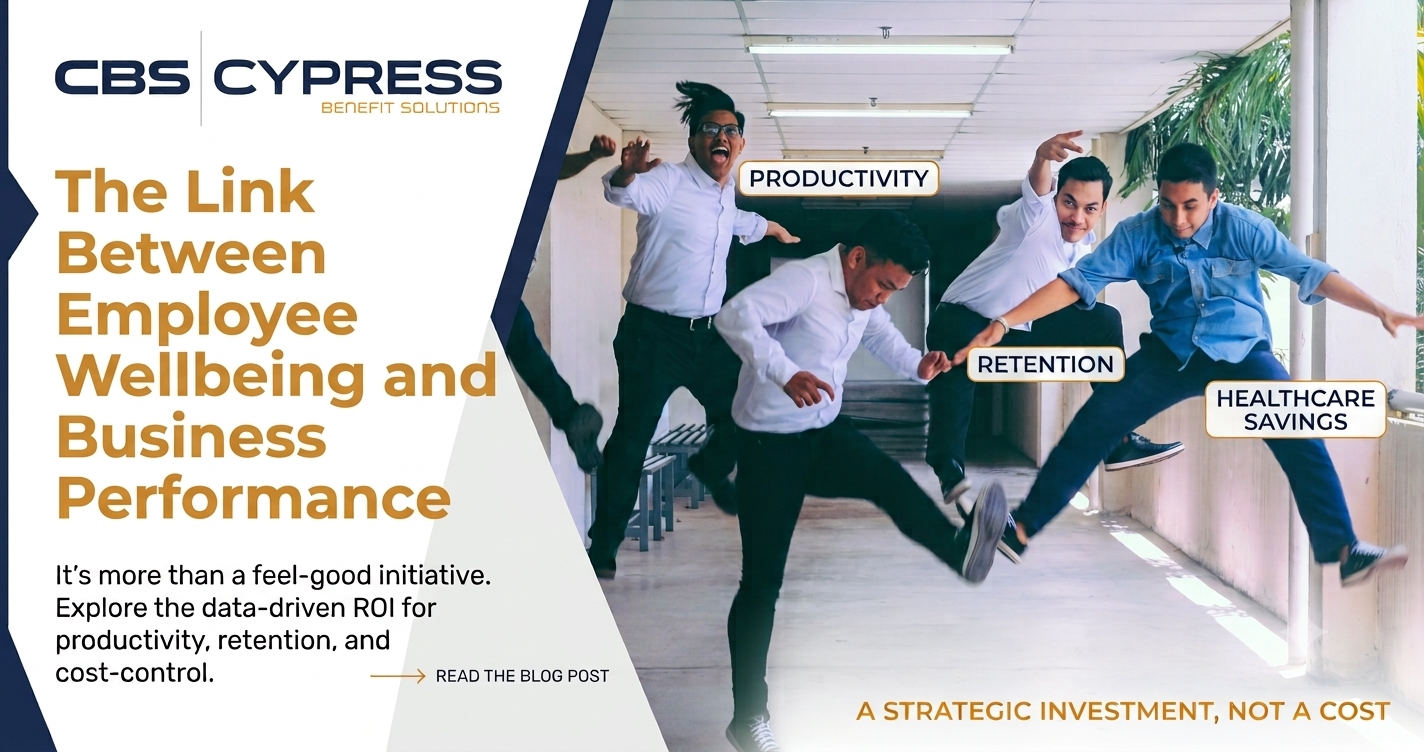
Employee wellbeing is not a soft topic. It is one of the most direct drivers of the business outcomes that matter most to owners and CFOs: productivity, attendance, retention, and healthcare costs. The employers who treat it as a strategic priority rather than a compliance exercise tend to build workforces that outperform, stay longer, cost less to insure, and are more capable of delivering on the organization’s goals.
The benefits package is one of the most powerful tools an employer has for supporting employee wellbeing. Not because any single benefit solves the whole problem, but because the cumulative signal that a well-designed, well-communicated benefits package sends to employees is that the organization sees them as whole people whose health and financial security matter, not just as labor units whose output needs to be maximized.
That signal has a return on investment. It just tends to show up in places that require deliberate attention to measure and attribute correctly.
At Cypress Benefit Solutions, we help employers think about their benefits package not just as a cost to manage but as a strategic investment in the performance and sustainability of their workforce. If you would like to talk through how your current benefits program is supporting employee wellbeing and where the highest-return opportunities might be, we would welcome the conversation. Reach out anytime.