One of the more difficult situations an employer can find themselves in is opening a claims report and discovering that a significant portion of their health plan’s cost is being driven not by employees but by the spouses, children, or other dependents enrolled on the plan. It is a scenario that raises complicated questions that touch on finances, fairness, legal obligations, and the very human reality that behind every large claim is a family going through something serious.
High-cost dependent claims are more common than many employers realize, and they are one of the least discussed topics in employer benefits conversations. Most brokers do not raise it proactively and most employers do not know what their options are until they are already feeling the financial impact. This post is designed to change that by giving employers a clear and honest picture of what is actually happening when dependents drive claims costs, what tools are available to address it, and how to navigate the situation in a way that is both financially responsible and genuinely supportive of the employees and families involved.
Understanding Why Dependent Claims Matter So Much
In most employer health plans, dependents including spouses and children represent a significant portion of the enrolled population and an even larger portion of total claims cost. This is not inherently a problem. Dependent coverage is a valued benefit and a meaningful part of what makes an employer’s total compensation package competitive. The issue arises when a small number of dependents generate claims that are disproportionate to the rest of the plan population and begin to meaningfully affect the employer’s overall cost trajectory.
On a self-funded or level-funded plan, high-cost claimants of any kind are visible in the claims data and their impact on plan performance is direct and measurable. On a fully insured plan, the individual claims driving the renewal increase may not be visible to the employer, but they are absolutely influencing the carrier’s pricing. A plan year with several large dependent claims will show up in a higher renewal, even if the employer cannot see the specific claims behind it.
The concentration risk is real. In many smaller employer plans, a single dependent with a serious illness, a premature birth, a complex surgical situation, or an ongoing specialty medication regimen can account for several hundred thousand dollars in annual claims. When a plan covering 75 or 100 employees has one or two dependents in that category, the financial impact on the plan is significant and the renewal consequences can be severe.
What Employers Can and Cannot Do
Before discussing tools and strategies, it is essential to establish a clear understanding of the legal boundaries in this space. The rules here are not ambiguous and violating them carries serious legal and reputational risk.
What Employers Cannot Do
Employers cannot remove a dependent from the plan because of their claims history or health status. The ACA prohibits discrimination based on health status in group health plan enrollment and eligibility. An employer cannot terminate a dependent’s coverage because they are sick, restrict access to benefits for a specific individual, or make coverage decisions designed to exclude high-cost individuals from the plan. Doing so exposes the employer to significant legal liability under the ACA, ERISA, and potentially the Americans with Disabilities Act depending on the nature of the condition involved.
Employers also cannot use claims data to identify specific employees whose dependents are driving costs and treat those employees differently in employment decisions. That path leads directly to HIPAA violations, ERISA claims, and potentially discrimination lawsuits. The information in a claims report is aggregate and protected, and it must stay that way.
What Employers Can Do
Within those boundaries, which are firm and non-negotiable, there is actually a meaningful range of tools and strategies available to employers who are dealing with high dependent claims costs. The key is understanding that the goal is to support better outcomes for the individuals involved while managing the plan’s financial sustainability, not to penalize anyone for being sick.
Tool One: Stop-Loss Insurance and Its Specific Dependent Protections
For employers on self-funded or level-funded plans, stop-loss insurance is the first and most fundamental tool for managing high-cost claimant risk of any kind, including dependent claims. As we covered in our self-funding post, specific stop-loss coverage reimburses the employer once any single claimant’s annual claims exceed a defined threshold, protecting the plan from catastrophic individual claim exposure.
What some employers do not realize is that stop-loss coverage applies to dependents as well as employees. A spouse or child who generates $400,000 in claims in a plan year will trigger the specific stop-loss coverage just as an employee would, capping the employer’s out-of-pocket exposure for that claimant at the defined attachment point.
For employers who are already experiencing high dependent claims and are concerned about future exposure, a conversation with their benefits advisor about the adequacy of their current stop-loss structure is an important starting point. Specific attachment points that were set based on historical claims experience may need to be reviewed if the plan’s risk profile has changed. In some cases, laser provisions in stop-loss contracts may also come into play, meaning the stop-loss carrier may exclude or set a higher attachment point for a known high-cost claimant at renewal. Understanding how this affects the plan’s financial position and evaluating alternatives is a conversation that requires a knowledgeable advisor.
Tool Two: Care Management and Case Management Programs
One of the most effective and most underutilized tools for managing high-cost claims of any kind is care management. The premise is straightforward: connecting individuals who have complex, high-cost health situations with dedicated clinical support tends to produce better health outcomes, and better health outcomes typically mean lower long-term claims costs.
Most carriers and many third-party administrators offer case management programs that assign a dedicated nurse or care coordinator to members with serious or complex conditions. The case manager works with the individual and their care team to ensure they are receiving evidence-based treatment, coordinating care across providers, avoiding unnecessary hospitalizations or procedures, and accessing appropriate resources including second opinion services and centers of excellence for complex diagnoses.
For dependents with serious conditions, these programs can be genuinely valuable on two levels. They can improve the quality of care the individual receives, which matters enormously to the employee whose family member is involved. And they can reduce the total cost of care over time by ensuring that treatment is appropriate, well-coordinated, and not duplicative. An employer whose plan includes a case management program should make sure that the program is actively being offered to high-cost claimants, including dependents, rather than sitting as an unused feature of the benefit package.
Tool Three: Centers of Excellence and Second Opinion Programs
For dependents facing serious diagnoses including cancer, complex cardiac conditions, rare diseases, or major surgical interventions, access to a center of excellence can make a meaningful difference in both outcomes and cost. Centers of excellence are high-volume, highly specialized facilities with demonstrated expertise in treating specific conditions, and research consistently shows that patients treated at centers of excellence for complex conditions have better outcomes and lower complication rates than those treated at general hospitals.
Many self-funded plan designs include a center of excellence benefit that covers travel and lodging for the employee and a companion when accessing care at a designated center. For a dependent with a serious diagnosis, encouraging the family to explore a center of excellence consultation is both a genuine act of support and a financially sound plan design feature. Some employers also offer standalone second opinion programs that connect members with independent expert physicians for a review of their diagnosis and treatment plan, which can surface alternative approaches that are both clinically superior and less costly.
Tool Four: Dependent Eligibility Audits
One tool that is both legally appropriate and often produces meaningful results is a dependent eligibility audit. These audits verify that every dependent currently enrolled on the plan actually meets the plan’s eligibility criteria. Spouses who have divorced, children who have aged out of eligibility, stepchildren who no longer qualify, or other dependents who were enrolled correctly at one time but whose circumstances have changed are all categories that can result in ineligible individuals remaining on a plan long after they should have been removed.
Research on dependent eligibility audits consistently finds that a meaningful percentage of enrolled dependents, typically between 3% and 8% of the dependent population, do not meet eligibility criteria when documentation is actually verified. Removing ineligible dependents reduces plan enrollment, reduces premium or claims exposure, and ensures that the plan’s resources are being used appropriately. This is a compliance exercise as much as a cost management one, and it is something employers should consider conducting periodically rather than only when costs are already elevated.
It is worth emphasizing that a dependent eligibility audit does not target high-cost claimants. It verifies eligibility for all dependents uniformly and removes those who do not qualify regardless of their claims history. That distinction matters both legally and ethically.
Tool Five: Reviewing the Dependent Contribution Strategy
While an employer cannot remove a dependent from the plan because of health status, they do have flexibility in how they structure the cost-sharing between the employer and employee for dependent coverage. Dependent coverage is not required to be subsidized at the same level as employee coverage, and many employers have not revisited their dependent contribution strategy in years.
Some employers choose to cover 100% of the employee-only premium while requiring employees to pay the full incremental cost of adding dependents. Others split the dependent premium at various levels. Reviewing the current contribution structure and understanding how it compares to market benchmarks is a legitimate plan design conversation that is separate from any individual’s claims experience. If dependent coverage has become disproportionately subsidized relative to the claims costs it generates, adjusting the contribution split at renewal is a reasonable and legally appropriate response.
This is not a tool for targeting specific individuals. It is a plan design decision that applies uniformly to all employees with dependents and is evaluated based on overall plan economics rather than any individual’s situation.
Tool Six: The Working Spouse Affidavit and Spousal Carve-Out
One of the most practical and widely used tools for managing dependent costs, and one that is often overlooked in this conversation, is the working spouse affidavit, sometimes called a spousal carve-out or working spouse provision. It is a plan design feature that is legally permissible, increasingly common among employers of all sizes, and can produce meaningful cost savings when structured appropriately.
A working spouse affidavit requires employees who want to enroll a spouse on the employer’s health plan to certify that the spouse either does not have access to other employer-sponsored coverage or has access to coverage that does not meet a defined affordability or benefit threshold. In its simplest form the affidavit is an annual attestation completed during open enrollment. It does not require documentation of the spouse’s employer’s plan in most implementations, but it does put the employee on record regarding their spouse’s coverage situation.
The Spousal Carve-Out
A stronger version of this provision is the full spousal carve-out, which excludes spouses entirely from the plan if they have access to coverage through their own employer, regardless of the cost or quality of that coverage. Under a spousal carve-out, a spouse who is offered any employer-sponsored plan through their own job is simply not eligible to enroll on the employee’s plan. This is the most aggressive version of the tool and the one that produces the largest cost reduction, but it also carries the most potential for employee relations friction and needs to be communicated carefully.
The Spousal Surcharge
A more moderate approach that many employers find easier to implement is the spousal surcharge. Rather than excluding spouses with other coverage options, the plan charges those spouses a higher premium contribution, typically an additional $50 to $200 per month, if they have access to their own employer’s plan and choose to enroll on the employee’s plan instead. The surcharge creates a financial incentive for spouses to use their own employer’s coverage when it is available without creating a hard exclusion that removes the option entirely.
Why This Tool Is Relevant to Dependent Cost Management
The working spouse provision is relevant in the context of high-cost dependent claims for a straightforward reason: spouses are statistically the highest-cost dependent category on most employer health plans, and a meaningful percentage of enrolled spouses have access to coverage through their own employer. An employer who is absorbing significant spousal claims costs may be doing so for spouses who could be covered elsewhere.
It is important to be clear about what this tool does and does not do. A working spouse provision applies uniformly to all enrolled spouses based on their access to other coverage. It does not and cannot target spouses based on their health status or claims history. An employer who implements this provision does so as a plan design decision that affects all employees with spouses equally, not as a response to any individual’s situation. That distinction is essential both legally and ethically.
For employers who have not yet considered a working spouse affidavit or surcharge, the upcoming renewal cycle is a natural time to evaluate whether adding this provision makes sense. The financial impact can be significant and the implementation is straightforward when communicated clearly and with appropriate lead time for employees to make alternative arrangements if needed.
The Human Dimension: How Employers Should Think About This
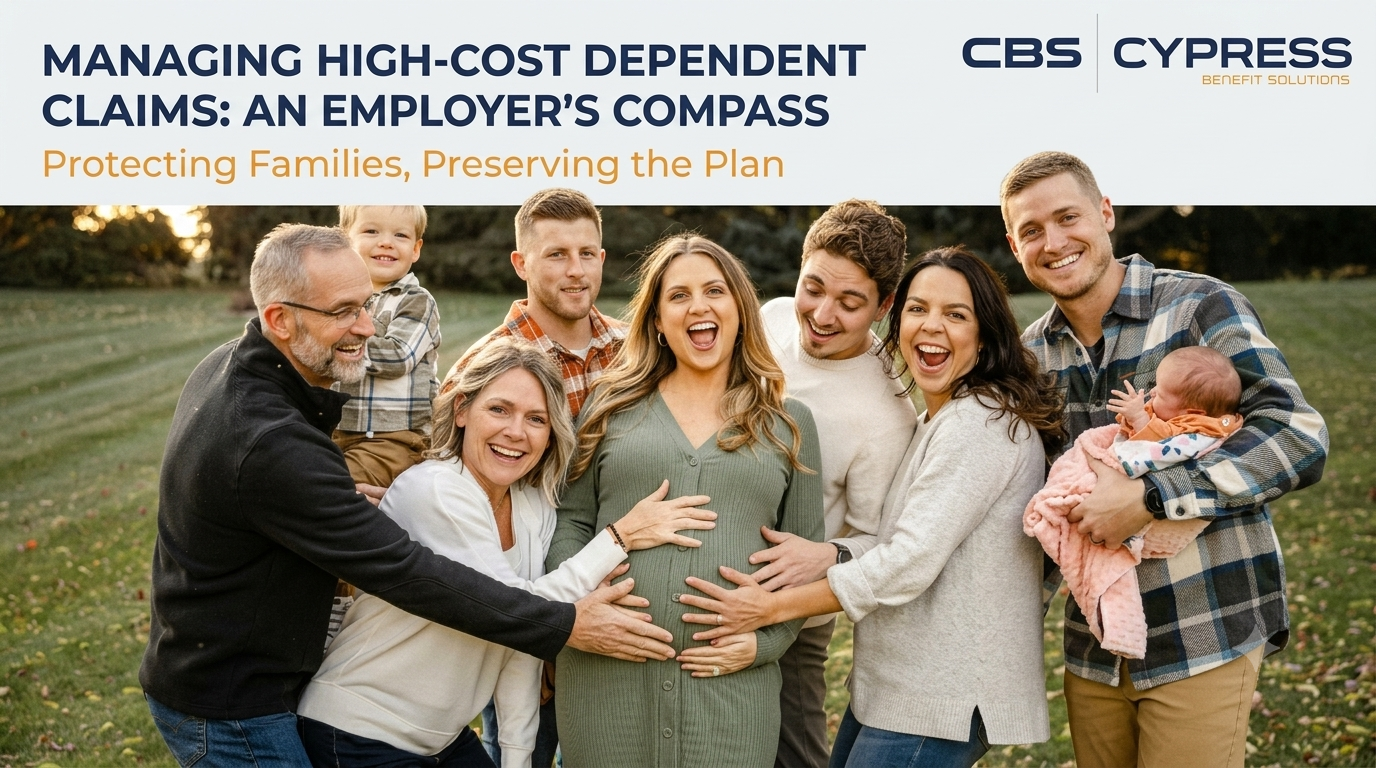
Everything covered above is worth discussing in the context of a reality that employers navigating this situation understand deeply: behind every high-cost dependent claim is a real family dealing with something serious. A child with a rare disease. A spouse undergoing cancer treatment. A dependent managing a complex chronic condition. These are not abstractions on a claims report. They are people who matter to your employees and, by extension, to you as their employer.
The employers who navigate high-cost dependent situations most effectively are the ones who hold both realities simultaneously. They take the financial sustainability of the plan seriously because the plan serves the entire workforce and its long-term viability matters. And they approach every individual situation with genuine compassion and a commitment to connecting families with the best possible care and support resources available through the plan.
That means making sure case management is actively offered and explained. It means ensuring employees know about centers of excellence and second opinion programs before they need them rather than after. It means having an HR team that responds to benefits questions from affected employees with warmth and practical help rather than bureaucratic distance. And it means having a benefits advisor who understands that their job in these situations is to help the employer be a good partner to their employees, not just to manage a claims number.
How Cypress Benefit Solutions Approaches This
High-cost dependent situations are among the most sensitive and complex conversations in benefits advisory, and they require an advisor who is comfortable with both the financial analysis and the human context. At Cypress Benefit Solutions, we help employers think through these situations with clear information, appropriate tools, and a genuine understanding that doing right by the plan and doing right by the employee are not mutually exclusive goals.
If your claims data is showing significant dependent claims concentration, if your stop-loss structure has not been reviewed recently, or if you are not sure whether your plan includes the case management and care coordination resources that could make a real difference for affected families, those are conversations worth having. Reach out anytime and we would be glad to sit down and work through it together.