Over the past several weeks we have covered two alternative approaches to the traditional fully insured group health plan: self-funding, where employers pay claims directly with stop-loss protection, and ICHRAs, where employers give employees a defined contribution to purchase their own individual coverage. Both represent meaningful departures from the status quo and both have real potential to produce better outcomes for the right employer.
This week we are covering the third major alternative that most employers in the small and mid-size market have never had explained to them: reference-based pricing. It is one of the more powerful cost management tools available, one of the least understood, and one that a meaningful number of employers are now using to break the cycle of annual premium increases that has become the defining feature of traditional health plan management.
This post explains what reference-based pricing is, how it works in practice, what the real advantages and challenges look like, and how to think about whether it belongs in a conversation about your health plan.
What Reference-Based Pricing Actually Is
To understand reference-based pricing it helps to first understand how providers get paid under a traditional insurance arrangement, because that context makes the alternative approach much clearer.
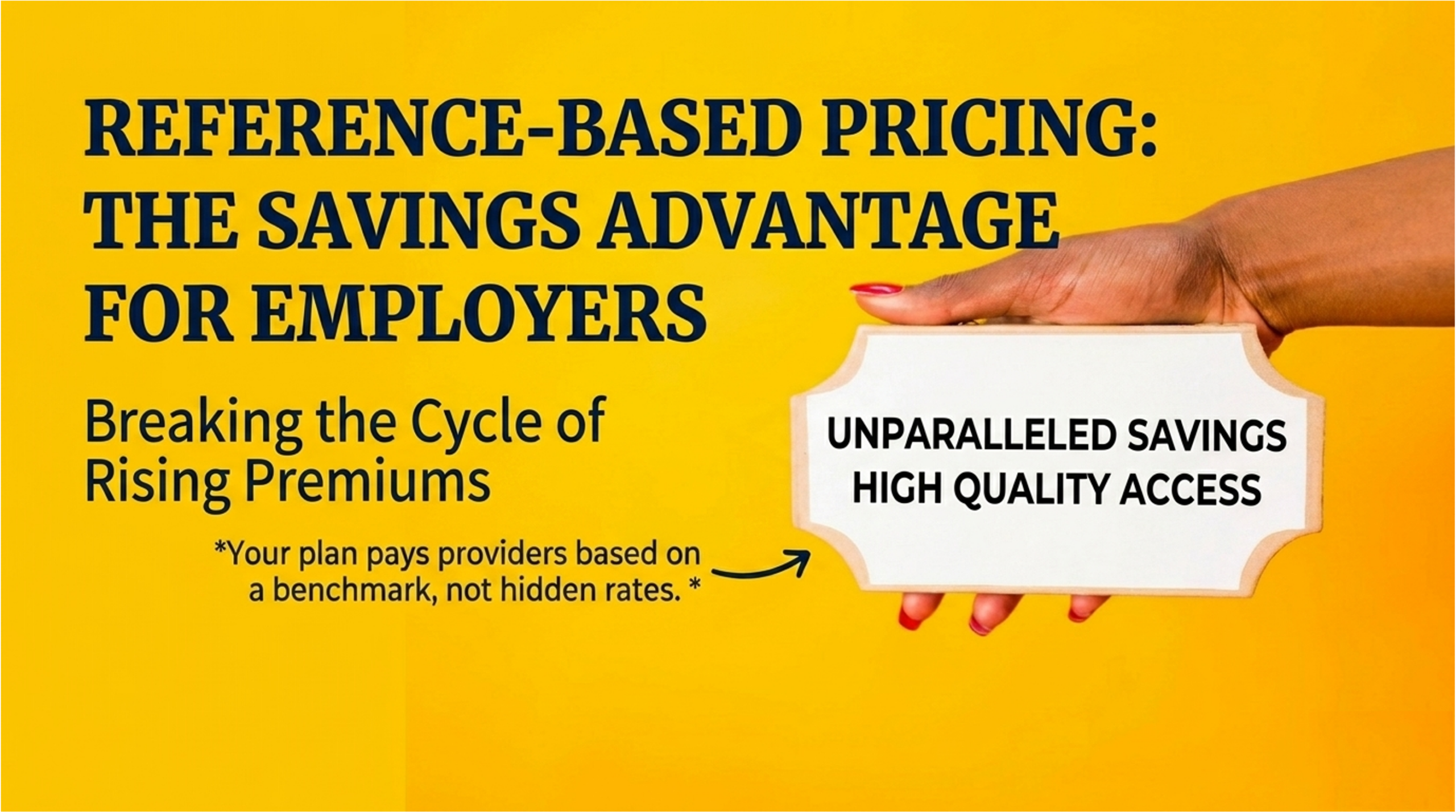
When you purchase a fully insured health plan or access a carrier network as a self-funded employer, your plan pays providers based on rates negotiated between the carrier and each hospital or physician group. Those rates are proprietary, meaning neither the employer nor the employee knows what the carrier agreed to pay for a given service. What is known is that negotiated rates vary enormously from provider to provider and market to market, and that in many markets hospital consolidation has given large health systems significant leverage to negotiate rates that are far above what independent benchmarks would suggest is reasonable.
Reference-based pricing takes a different approach. Rather than paying whatever rate a carrier has negotiated with a provider, a reference-based pricing plan pays providers a defined amount tied to an external benchmark, most commonly Medicare reimbursement rates. The plan might pay 140%, 150%, or 200% of what Medicare would pay for the same service at the same facility. That benchmark becomes the reference point, hence the name, and it replaces the carrier-negotiated rate as the basis for provider payment.
The result, when the model works as intended, is that the employer pays significantly less for the same medical services than they would under a traditional negotiated-rate arrangement, because Medicare-based benchmarks are typically well below what commercial carriers pay hospitals, particularly in markets where a dominant health system has used its leverage to push negotiated rates higher.
How Reference-Based Pricing Works in Practice
Reference-based pricing is almost always implemented in conjunction with a self-funded plan structure, because the employer needs to control the claims payment mechanism in order to apply the reference-based methodology. It is not typically available as a feature of a fully insured plan.
In a reference-based pricing arrangement, the plan administrator processes claims by calculating the reference-based payment amount for each service and issuing payment accordingly. Most providers receive the payment without issue. Some providers, particularly large hospital systems that are accustomed to higher commercial rates, may bill the employee for the difference between what the plan paid and what the provider billed, a practice known as balance billing.
The balance billing risk is the most significant challenge in reference-based pricing and the one that requires the most careful management. Employers who implement this model typically partner with a reference-based pricing vendor or third-party administrator that provides member advocacy services, meaning they assign a dedicated advocate to work with any employee who receives a balance bill and negotiate with the provider on their behalf. In the large majority of cases these negotiations result in the balance bill being reduced or eliminated. But the process requires employee support and the employer needs to be committed to providing it.
Many reference-based pricing arrangements also include a supplemental insurance layer that protects employees from any balance billing exposure above a defined threshold, providing an additional safety net that makes the model more employee-friendly in practice than it might appear on paper.
Where the Savings Come From
The cost savings potential in reference-based pricing is real and for many employers it is substantial. Studies of employers who have implemented reference-based pricing consistently show claims cost reductions in the range of 15% to 40% compared to traditional negotiated-rate arrangements, depending on the market, the provider mix, and the specific benchmark multiples used.
The savings are largest in markets where commercial carrier rates have been pushed significantly above Medicare benchmarks through provider consolidation and negotiating leverage. In markets where commercial rates are already relatively close to Medicare, the savings are more modest but still meaningful.
The mechanism is straightforward. If a hospital bills $50,000 for a procedure and the carrier has negotiated a rate of $30,000, the traditional plan pays $30,000. If Medicare would pay $15,000 for the same procedure and the reference-based pricing plan pays 150% of Medicare, the plan pays $22,500. The employer saves $7,500 on that single claim. Across a full plan year with many claims, those savings accumulate significantly.
It is worth noting that reference-based pricing does not reduce access to care. Employees can see any provider they choose, including hospitals and specialists that are not part of any traditional carrier network. The plan pays based on the reference benchmark regardless of whether the provider is in a network. For employees who value that kind of provider freedom, particularly those in areas with limited network options, reference-based pricing can actually expand their practical access to care.
The Real Challenges Worth Understanding
Reference-based pricing produces real savings for many employers, but it also comes with genuine challenges that need to be understood and managed carefully. An honest evaluation has to include both sides of the picture.
Balance Billing and Employee Experience
The balance billing dynamic is the most significant operational challenge in reference-based pricing. When a hospital receives less than its billed or contracted rate, it may send a bill to the patient for the difference. For an employee who does not understand why they are receiving that bill or what to do with it, the experience can be alarming and frustrating even if the situation is ultimately resolved in their favor.
Managing this well requires a committed employer, a capable reference-based pricing vendor with strong member advocacy resources, and ongoing employee education that sets clear expectations before a balance bill arrives. Employers who implement reference-based pricing without investing in these elements tend to have poor employee experiences even when the financial outcomes are favorable. Those who invest in them tend to find that balance billing issues are resolved efficiently and that employee satisfaction with the model improves over time as familiarity grows.
Provider Resistance in Some Markets
In markets dominated by large health systems, some providers may refuse to accept reference-based pricing payments or may be more aggressive about pursuing balance billing. This is more common in certain geographies than others, and understanding the provider landscape in your specific market is an important part of evaluating whether reference-based pricing is a practical fit. A knowledgeable advisor can help you assess the likely provider response in your area before committing to the model.
Requires a Self-Funded Plan Structure
As noted above, reference-based pricing requires the employer to be self-funded, which means taking on the responsibilities that come with that structure including stop-loss insurance, TPA administration, and claims payment. For employers who are not yet self-funded and are not ready to make that transition, reference-based pricing is not immediately accessible. It is best evaluated as part of a broader conversation about funding strategy rather than in isolation.
Employee Communication Is Non-Negotiable
Reference-based pricing is meaningfully different from what most employees have experienced under a traditional plan, and that difference needs to be explained clearly before employees encounter it in a real claims situation. Employers who do not invest in thorough employee education before launching a reference-based pricing plan tend to generate confusion and frustration that undermines the model’s effectiveness and erodes employee trust. The communication investment is not optional. It is a fundamental part of making the model work.
Who Reference-Based Pricing Tends to Work Best For
Reference-based pricing is not the right answer for every employer, but it deserves serious consideration from a wider range of companies than currently evaluate it. The employers who tend to benefit most share a few common characteristics.
They are already self-funded or are seriously considering making the transition. They operate in markets where commercial carrier rates are significantly above Medicare benchmarks, which is increasingly common in markets with dominant hospital systems. They have leadership that is committed to a different model and willing to invest in the employee education and advocacy support needed to manage the balance billing dynamic well. And they have a benefits advisor who is genuinely knowledgeable about how reference-based pricing works in practice, not just in theory.
Employers who meet those criteria and are frustrated by years of above-average renewal increases should have this conversation. The potential savings are real, the model is more established than many employers realize, and the risks are manageable with the right structure and support.
Putting It All Together: The Alternative Funding Landscape
Over the past several weeks we have covered three distinct alternatives to the traditional fully insured group health plan: self-funding, ICHRAs, and reference-based pricing. Each represents a different way of thinking about how employer-sponsored health benefits are structured and financed, and each has a distinct set of advantages, limitations, and ideal use cases.
What they share is that they are all conversations most employers in the small and mid-size market have never had with their broker, either because the broker is not familiar with the models or because they prefer the simplicity of renewing a fully insured plan. That gap is where Cypress Benefit Solutions operates differently.
At Cypress Benefit Solutions, we believe every employer deserves a clear and honest evaluation of the full range of options available to them, not just the ones that are easiest to explain or administer. That includes self-funding, ICHRAs, reference-based pricing, level-funded arrangements, captive models, and whatever combination of strategies makes the most sense for a specific employer’s workforce, market, and goals.
If any of the concepts covered in this series have sparked questions about your own health plan and whether there might be a better structure available to you, that is exactly the conversation we would welcome. Reach out anytime and we would be glad to start with an honest assessment of where you are and what your options look like.