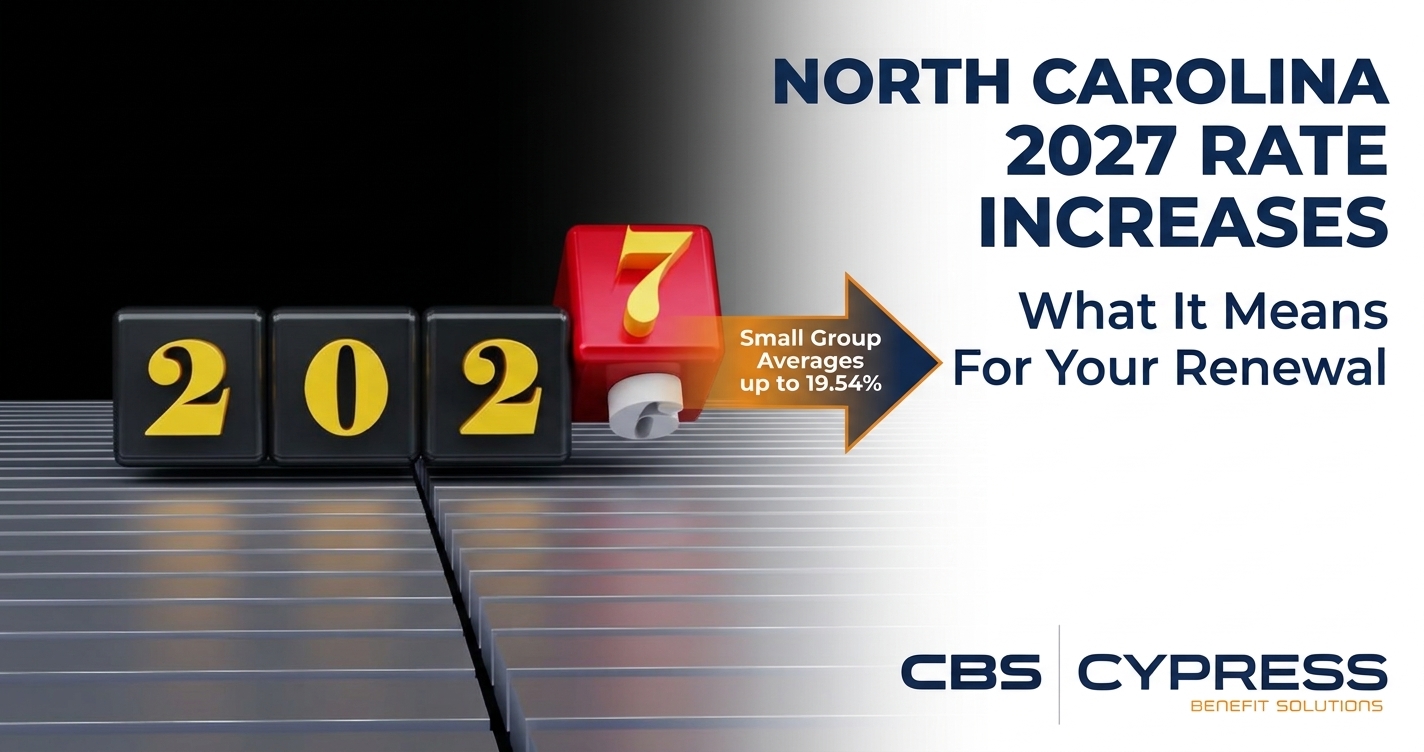
On October 30, the North Carolina Department of Insurance released the approved ACA health insurance rates for 2027. In the small group market, the approved average increases range from 18.78 percent to 19.54 percent. In the individual market, approved increases range from 8.35 percent to 27.36 percent. The Insurance Commissioner pointed to the rising cost of claims, health care, and prescription drugs as the reason premiums continue to climb.
Numbers like these tend to get repeated quickly, and they are easy to misread. This post explains what the state approved, what the numbers do and do not tell an employer about its own renewal, and what to do with the information as 2027 renewals arrive.
What the State Approved
For coverage effective January 1, 2027, the department completed its review of the filings and published the approved rate changes.
- Approved average rate changes in the small group market range from 18.78 percent to 19.54 percent.
- The averages are annualized, and actual changes vary by plan, geographic area, and tobacco status. A specific employer can see a rate change that is higher or lower than the average.
- Federal law requires an insurer to provide a consumer-friendly explanation of the rate change whenever any plan in its filing has an approved increase of 15 percent or more. These explanations are available through the federal rate review website and on each filing in the state’s public viewing portal.
- The department notes that rates are affected by increases in claim costs for hospitals, doctors, and prescription drugs, by medical inflation, by changes in insurer network arrangements, and by increases in the use of health care services or more expensive care.
Why This Matters to Employers of Every Size
The approved filings are a public, regulator-reviewed view of what carriers expect to happen to health care costs in North Carolina in 2027. The cost drivers the state names, which are hospital and physician costs, prescription drugs, medical inflation, and utilization, are not unique to a particular group size. Carriers are generally pricing all of their groups against the same underlying cost pressures.
That makes these figures a reasonable signal about the direction and the general size of the pressure heading into 2027. There is an important detail to keep in mind. The filings themselves cover the small group market, and larger groups are generally priced on their own experience and the carrier’s own pricing approach. A figure near 19 percent is therefore a signal and not a prediction of what any specific renewal will be.
What the Number Does Not Tell You
- Your own renewal. Claims history, demographics, plan design, and funding structure all matter, and these can move a renewal well above or well below a market average.
- Whether your current plan is competitive. An average increase says nothing about whether your carrier, network, and plan design are the best fit at the price you pay.
- Whether you have alternatives. Other carriers, different plan designs, and different funding structures can change the picture, and the only way to learn whether they do is to market the plan.
What an Employer Can Do With This Information
- Ask your advisor now for a projected renewal range, instead of waiting for the rate to arrive.
- Review your claims and utilization data to understand how much of your cost pressure comes from your own group and how much comes from the market.
- Ask for a market analysis, including other carriers, plan designs, and, where it fits, level-funded or self-funded options.
- Decide in advance how any increase will be shared between the company and employees, so that the contribution discussion does not happen under time pressure.
- Build the 2027 budget around a range of outcomes, not a single number.
Questions to Ask Your Advisor
These are the questions worth putting to your advisor as 2027 renewals arrive.
- How do the state’s approved increases compare with what you expect for my group, and why?
- How much of my expected increase comes from market trend, and how much comes from my own claims experience?
- When will I see my renewal, and what will you bring me before it arrives?
- Which alternatives have been or will be quoted, and how were they chosen?
- What options exist, beyond accepting the renewal as presented, to manage the cost for 2027?
- What would each plan design or contribution change mean for my employees?
At Cypress Benefit Solutions, we believe market data is only useful once it has been translated into what it means for a specific group. If you would like help understanding what the 2027 rates mean for your renewal, or whether you have seen the full market, we would welcome the conversation.